One of the things I enjoy the most in homebrewing is experimenting with different yeasts and bacterias. I’ve said it before that when I was brewing a lot at home and entering competitions I felt like using blends of strains or the latest limited yeast release was key in my wins. Some brewers love getting that new hop variety everyone wants this year…others love trying new fermentable sugar, but for me it’s always been about the microbes.
I’ve been fortunate enough to take that love of microbes to the next level at Yazoo by continuing to procure interesting and unique strains to build the program around. Since last summer I’ve done single microbe fermentation test batches using close to 20 different wild yeasts and bacterias. It has given me a great appreciation for what each microbe can offer and if certain ones are even worth using. It takes a little longer to build a program this way, but I believe it’s the only way to create something fun and unique for people to drink. With so many breweries and homebrewers making good sour/wild beer with the usual suspects from the major yeast labs, I feel like testing many unique strains will translate into great beer.
We’ve released a few of these test beers throughout the year, but I’m really excited about the ones we will release this Sunday at Funk Fest. Back in January my buddy Dmitri (who I’ve known for a few years through homebrewing boards and runs this awesome website) sent me samples of Brettanomyces he had isolated from a bottle of Cantiilon Iris. He was able to identify 3 different Bretts in the 2007 Iris. In chatting with him they all sounded like familiar descriptions of the flavor layers I love in Cantillon, so I was more than excited to kick off batches with these Bretts!
Fast forward a little over 8 months later….the beers are finished and kegged up. These Cantillon single Brett isolated beers called: Breaking Brett C1, Breaking Brett C2 and Breaking Brett C3 will debut this Sunday at the Yazoo for our sold out Funk Fest. I wanted to make these available at the same time so people could taste the differences in the Brett side by side.
We are also releasing “The One Who Knocks” – A Brett Saison in Chardonnay Hungarian Oak aged on Golden Raisins and our summer seasonal “Lange Sommer” (translation: Long Summer) – our take on Berliner Weisse. I’m really happy with how lactic balanced and drinkable the Berliner Weisse is. It hit a good final ph of 3.7 so it has enough sour to let you know it’s there, but not so sour it turns your stomach after 2 glasses. What fun is a Berliner you can’t drink a gallon of when it’s 100 degrees outside?!?!!?
**Edit** Because some have asked: The Berliner Weisse used Lactobacillus Delbrueckii to sour. It was pitched into the conical first at around 100F where it sat for a few days then we pitched our fermenting microbes.
So 5 new sour/wild beers this weekend in Nashville! Please don’t wake me from this dream! haha
I’m planning to give out a little more data and descriptions to the attendees about C1, C2 and C3 during a short presentation at the release this weekend, so I’m going to hold off on posting it here until after then. But I will say all 3 variants achieved over 96% attenuation pitched into a 1.051 og wort consisting of wheat, pils, acid malt and 12 IBUs. All 3 taste and smell distinctly different with delicate character. It amazed me at how “smooth” and rounded these variants are compared to some of the other variants I’ve tested.
This weekend is shaping up to be a fun one beer wise and the return of what you guys know is my favorite show: Breaking Bad.
What funk have you guys brewed lately? Have you experimented with any new ingredients?
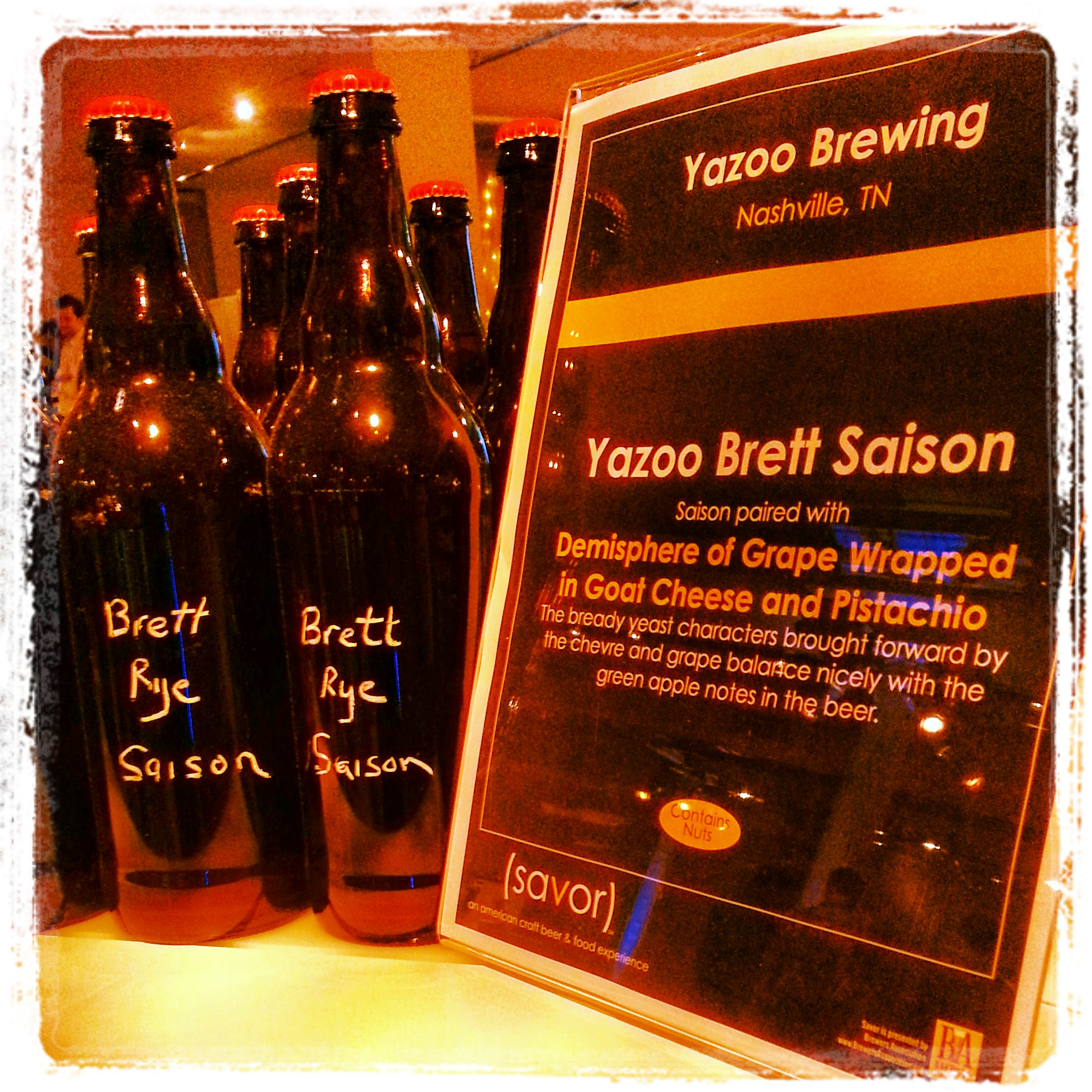
As many of you know I had an awesome opportunity to showcase 2 beers I worked on at Yazoo during SAVOR last weekend in New York. What an incredible experience the weekend turned out to be! Linus and I brought our Brett Rye Saison and Wild Child. I was really impressed with the pairings that Chef Adam Dulye from Monk’s Kettle chose for our beers.
Brett Rye Saison was paired with Demisphere of Grape Wrapped in Goat Cheese and Pistachio. I think I could’ve eaten an entire tray of these things, trust me they were THAT addictive!
Our Brett Saison was fermented with 3 strains. We used a Saison strain that I’ve had good luck using at home for about 7 years. It’s banked at a lab now and I believe it will be our Saison strain of choice going forward. We also used 2 strains of Brettanomyces pitched about 2 days into primary fermentation at 80F. I have a dedicated sour/wild stainless conical at the brewery now which is what we fermented this batch in, I plan on doing some barrel treatments next year.
Wild Child was paired with Glazed Short Rib of Beef with Soft Polenta and Crispy Leeks.
This was the first beer that Linus and I did for the Embrace The Funk series. It is a blend of 2 barrel aged beers. Last summer we took SUE (which is a Cherrywood Smoked Porter) fermented it with Brettanomyces Lambicus and Cherries in a Consecration barrel Vinnie gave us. When we were happy with the character of the beer the barrel was emptied and we fermented Dos Perros (which is a Mexican/Vienna lager style) fermented it with the same Brett, added some more cherries and put it into the same barrel. These 2 beers were blended at around 30% ETF SUE and 70% ETF Dos Perros.
I had a great time in New York actually meeting people who are regular readers of this website and I was humbled by the ones who said they are making better beer because of this website.
Some other cool/neat/funny things:
Getting a beer poured and served to me by Peter Bouckaert of New Belgium. An absolute legend! I only wish it could’ve been La Folie though…
Getting interviewed by NPR for a story they are producing on American Sour Beers. The pic on the right is setting up for the interview.
The lady that told me I looked too clean cut to be a brewer, especially a sour brewer! That cracked me up.
Tørst . What an awesome draft selection and setup. Everything is served at the perfect temperature and the perfect carbonation level in truly “beer clean” stemware. I can’t say enough good about how nice and knowledgeable the staff is at Tørst. I will never miss a chance to sample beer there, we had Cantillon Vigneronne on draft!
Tomme Arthur saying I was “the funk guy”.
Having multiple people come back for seconds and thirds of Brett Saison and Wild Child because they liked it so much.
All You Can Eat Oyster Bar at the event!
Walking around in the Brooklyn Brewery with Linus who interned under Garrett Oliver when Brooklyn Brewery was just a few years old. Then as we were leaving a local who had visited Nashville a few times stopped us when he saw my Yazoo shirt to say how much he liked the beers.
Me and Linus serving up the funk!
As I said earlier, it was a great time all around. The Brewers Association picked out a great location and I feel like a majority of the beer I tasted was top notch. I hope I can make the trip again next year, I think SAVOR returns to Washington, DC in 2014.
*************************************************
Now some more technical talk! Here is something my friend Levi over at Funk Factory and I have been working on….A Brettanomyces strain guide that will hopefully be of some help to everyone. We will update and tweak the chart as needed, but we felt like we had enough information to go ahead and publish. Thanks to Al Buck over at East Coast Yeast and the others who wanted to remain in the background on this for their help. The chart is below (if you have an ad blocker enabled it might not show up).
ETF: What’s the temp range and the swing of the barrels? I haven’t seen the barrel room, but you said it’s inside of the brewery, so I assume there’s not a whole lot of temp change. Where are you guys sitting, temp-wise, on the barrels?
TROY: When we started aging these beers, we knew we wanted to keep them isolated. So we had a room that we stored all our malt in, and that room had air conditioning, so that was very nice and appealing. The room that it’s in, two of the walls are directly next to outside. When you have a very, very cold winter, I recorded temps in the low 40s. In the summer, the outside temperature maybe in the 100s, and it’s in the heart of our brewery, so that’s even hotter than outside. We work right in the heart of the Golden Brewery. Even with the air conditioner running, we can get into the 80s. And if we trip a breaker, I wouldn’t want to know how hot it could get over the weekend. That really scared me when we first started doing this, you read the literature and the Belgians say you can’t let it get that hot, right? But after talking to other brewers–
ETF: Unless you’re Armand and everybody goes crazy for a hot Kriek…
TROY: Ha. I see what you did there… But what are we going to do? I can’t move any of these barrels. This is our only opportunity. I talked to some other brewers locally who are in the same situation where it gets incredibly hot during the summer and very cold during the winter, to the point where the barrels are leaking because of how cold it is. I’ve since come to have the belief that the temperature change, though I’d like it to be less, is very important to the life cycle of these beers.
Some brewers control temperature year round with their barrels. I think it’s important to have a life cycle of hot and cold, because that’s what happens with Lambic. Even though we’re not making beer like Lambic, we still have a lot of the same bugs and critters in there. I think that’s important to have some dormancy if it’s cold out, and to get it hot, to let it go a little bit more and get it going. So it can definitely get hot to the point where I don’t sleep at night, but I haven’t tasted a barrel and said, “You know what? I think this barrel just got too hot” or “This barrel is bad because of temperature.” We’ve had plenty of barrels go bad for other reasons, but not because of temperature.
ETF: What are we talking on the temp swings inside the barrels?
TROY: So the coldest we got a couple years ago, the low 40s degrees Fahrenheit. The highest it can get to is upper 80s. But that’s for short periods of time. I’d say it can get over 90 if our air conditioner trips out, but that’s for a short period. But over a hot summer, it’s routinely in the lower 80s.
ETF: So when it gets hotter –and as far as your fruiting schedule goes, how far into the life cycle of that beer are you? How far into fermentation would you be when it does start getting up to the 80s and 90s?
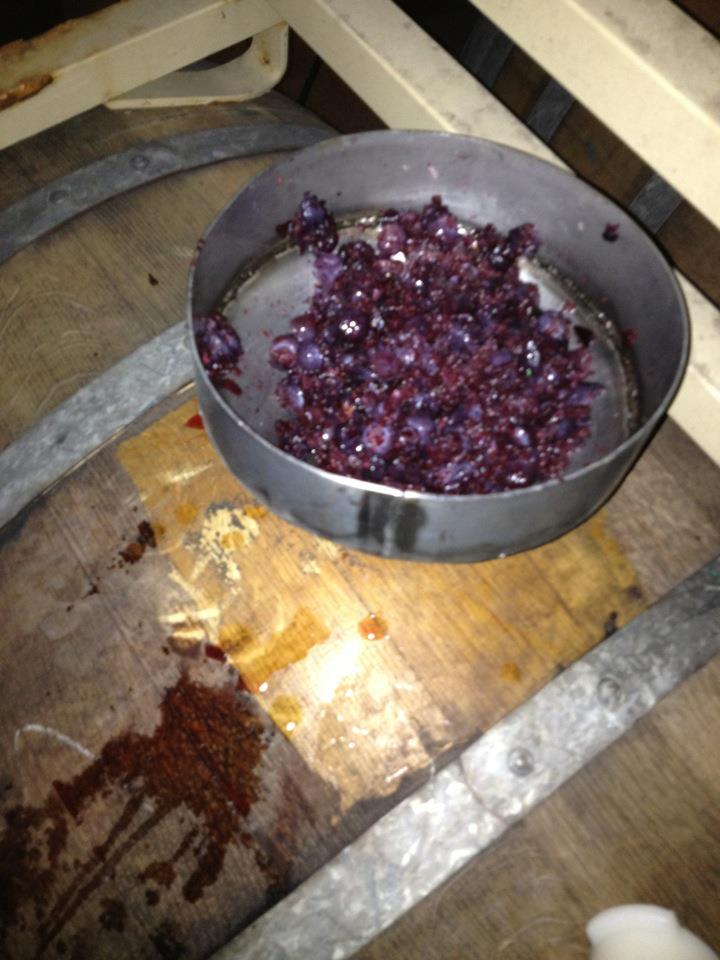
Adding Blueberries To A Barrel
TROY: It would either be at the end of the life cycle for a barrel or at the beginning. For instance, last year when June came around, we had apricots. So we emptied a lot of barrels onto the apricots. In turn, we had beer ready to go to refill those barrels, so at the end of June, we had young beer that had just got that starter culture. July comes around, we get our peaches, and that’s when it starts to get really hot. But we don’t get our blackberries until September, so we’ve got those barrels that are 10, 11 months old. We also have fresh barrels that are one, two, three months old when this heat is coming.
ETF: Are you guys staggering the microbe additions – are you adding the brett, lacto, and pedio at the same time, or doing brett for a little bit and then acidifying with bacteria?
TROY: Whenever we do a store-bought thing, yep, we’re definitely following the “Vinnie method” if you will…just adding the brett first, and then – we actually don’t really buy lacto anymore. We’re almost only using pedio.
We haven’t had to do a store-bought beer in a long time, though. Probably 2011 was the last time we bought bugs for this type of project. So from now on, we had the barrels that were the store-brought ones, we add the brett, we add just a little bit less than two million cells per ml of various strains of brett. Let that go for a couple months, and then we’ll add the lacto/pedio. If you ask me why, it’s because that’s what Vinnie says.
ETF: Haha …I mean, who’s going to argue with that?
TROY: Right? He’s making phenomenal beer. So that’s why we do it. I’ve only been doing this since 2009, so I don’t have enough internal data to say if that’s the best way or not, but it’s making great beer.
ETF: Well, you did mention that you guys are using more pedio now than lactobacillus in the beers. Do you feel like the lacto is maybe being suppressed by the alcohol at that point, and that’s why you guys are going with pedio to acidify?
TROY: I would say it’s been from the results we’ve gotten. I think at first when we tried it, let’s just say we were 50-50, lacto-pedio when we inoculated the barrels after a couple months with the brett. Then we tried one that was 75% pedio to 25% lacto, and that got more acidic.
Now it’s for two reasons; because if it was just pedio, it seemed to get more sour, a more pleasant sour. And it’s easier from a production standpoint, because we only have to deal with one strain of one microbe. It’s just simpler in that regard. When you have to inoculate 20 barrels, it’s easier just to order one thing from the supplier, especially if you know it’s going to give you a better result.
ETF: Which variant of lacto were you guys dealing with?
TROY: We get lacto and pedio from Wyeast.
ETF: When you’re adding the brett, would you consider that a secondary addition, when you guys are adding your brettanomyces?
TROY: Definitely. When we first started, we would add wort, or we would do a really under-modified mash to try to leave fermentables left. But it was more of a hassle to do that as opposed to just doing it the way we now know. What I’ve since found out in other processes, we’ve measured the sugar profiles of our fermented beer and learned that there’s plenty of maltose left and even maltotriose left, even in a very highly attenuating yeast strain, like the saccharomyces yeast strain. So I believe there’s plenty of sugars left, even the simple sugars, that saccharomyces could ferment. There’s plenty of simple sugars left in a normal beer that brett can chew on, no problem.
So from that standpoint, you’ve got fermentable sugars left; then it comes down to pitch rate, when it comes to the flavors that you want. Usually, to just simplify it, if you under-pitch, you get more flavors, either positive or negative, from whatever yeast strain you have. I believe with brett, it’s nicer to have the pitch lower than you might with saccharomyces, because the flavors that can come from stressing the Brett are vital to character. So when we pitch, we do less than two million cells per milliliter, total. That’s in the barrel. As soon as we fill the barrel, we add the Brett.
ETF: Have you guys done any 100% brettanomyces experiments? I’m curious about pitch rates if you have…
TROY: We have done one with a popular beer that is made in Golden. But I couldn’t tell you what the pitch rate was at all. We had some brett laying around, we just used that. It was interesting; it wasn’t any better than anything our normal yeast made.
Preparing 800lbs of Fresh Palisade Peaches
ETF: Okay, going back on the fruit for a second, there was a question that one of the readers of the blog had. What are your thoughts on when to add fruit? A timeframe for adding and then packaging the beer is what I think they are asking.
TROY: The peach sour that you had was the traditional lambic way I believe. You let it sour in the barrel, and then once the beer is sour enough, you add the fruit. That was our second batch of our Peche. The first batch of Peche, we added peaches into the barrel when we filled the barrel. Later, we added the lacto and the pedio.
It’s just a different flavor. The fruit, the bugs, the brett, whichever saccharomyces we’re using ferments the dextrins in that fruit significantly. We had a 5% alcohol lager go on 2 pounds per gallon fruit and when it was done, it was 8% alcohol. That definitely came from the fruit. As opposed to the peach sour that you’re trying now it was 5.4% alcohol when it went onto the fruit; when it was done, it was 5.7% maybe. And that was after two, three months. Only the simple sugars were consumed.
From the fruit flavor standpoint, which is what we want, it’s a method of preservation, preserving this fruit character. Because you’re not going to find any Palisade peaches right now in Colorado that are fresh. This is probably as fresh as it gets. So from that standpoint, we put it in as late as possible. We had barrels that we were happy with, that we did not expect would get more sour and we were happy with everything. All we wanted at that point of addition was the fruit flavor. So just let it go for another couple months on the fruit and filtered the fruit out with just a coarse filtration and packaged it.
ETF: So on the Peche batch that I had, what are we talking about as far as pounds per gallon of fruit?
TROY: I think technically somewhere around 1 ½ pounds per gallon.
ETF: And that was whole fruit, right? You guys only use whole fruit.
TROY: Yep only whole fruit. The Apricot is 2 pounds per gallon.
ETF: We were talking earlier about the acidity of Apricots and when I’ve tasted beers like Fou’ Foune, I’ve always felt like they were so smooth. But would you attribute that to the different types of apricots, or is that just something with apricots in a whole? Because I’ve never brewed with an apricot before.
TROY: I know what Cantillon says about their Fou’ Foune is that they can’t leave it on the fruit for more than two months because they think there’s some sort of yeast strain on it that can cause it to sour too much. I’ve only used whole apricots twice, so I’m by no means an expert, but what we found is that it sours really quickly too. I don’t believe it’s from a yeast strain; what I think is there’s more acidity in an apricot, and when you taste an apricot, you might not think it’s acidic, but it’s because of all the sugars that are there.
The longer you keep it in contact with a yeast strain that can ferment it, that A) ferments out easily those simple sugars, but then B) can go even deeper and pull more out. I think that’s where the increase of acidity comes from. I know when you age Fou’ Foune it becomes almost undrinkable, some people say. From the actual production side of it, I think it’s just a sour fruit that doesn’t come off as sour because of all the sugar that’s in it when you actually consume it, like so many fruits are. There’s a lot of different types of acid in them.
With apricots, it’s a very dense fruit. It’s not like peaches that’ll just melt. For a lot of people it’s not enjoyable because of the texture of the fruit. But there’s plenty of sugar in there, especially when you get them fresh and you rip them apart, and the juice is just dripping out. It’s just pure sugar and pure flavor. It’s amazing. But there’s a reason why apricots are not as popular as peaches, because they’re not as flavorful for the human palate. You put it in beer, you get phenomenal flavors, but you also deal with the increased acidity.
ETF: As far as water profiles, have you done any research or just played around with water profiles when brewing some of the beers that you guys are doing?
TROY: We just add a little bit of calcium chloride.
ETF: Are you guys doing that just to bump it up for yeast health and flocculation?
TROY: We use a little bit of calcium and it doesn’t hurt us. I’d rather have less calcium, I think, than more, mostly from the flavor standpoint. It has nothing to do with the technical brewing of sour beers. Sour beers are so much fun because I don’t have to worry about every technical aspect of it. Every day I come into work and I have to worry about micro-stability, I have to worry about not infecting our production beers. But when I get to make sour beers, I don’t have to worry about if this beer’s going to be ready in two days for transfer or packaging.
What’s so much fun about Lambic in general – not that I make Lambic, but a great quote, I think from Pierre Tilquin: he likes Lambic because all its secrets haven’t been revealed yet. That’s what I love about sour beers. I don’t have to worry about all these things I normally worry about with any of our production beers. It’s just fun; it’s all art. I mean, obviously there’s a huge amount of science in there, and Chad’s the one that can tell you that science. And that’s great, there’s nothing wrong with that.
But I love sour beers because I don’t have to worry about that. It’s all about the flavors and it’s all about production methods. So that’s where I think my skill is in making sour beers and the production methods. Not so much the science behind it, but the production methods.
Bottling, Cork and Caging At AC Golden
ETF: What would you call the distinction (besides the obvious) between an American Wild and a Belgian Lambic? Is there any flavor profile or characteristic one has, the other doesn’t? I’m always curious to hear what brewers have to say about the name game.
TROY: I think it’s really well summed up by saying American Wild Ale as opposed to Belgian Lambic. Because what we as Americans are making, for the most part, is much different than what the Belgians are making. Not from the spontaneous inoculation side, but just what we’re trying to achieve.
I can talk about that from what we’re making. We’re really not trying to have the same flavor characteristics that the Belgians are. We have some similar ones, but not the same. When we make sour beer, the thing that we’re looking for is acidity. And that’s not what the Belgians are looking for. Obviously, it needs to be there, but for the American brewers, I feel like on the most part that are making American Wild Ales, we have to wait until the beer becomes sour, and then we can do something with it.
On the Belgian side, the acidity comes very early in the process. The sour is not hard to get at all. You and I have both tasted a lot of American sours that aren’t that sour, and in that respect can be hard for American brewers, because we like to use a lot of hops. So it can be hard for American sour producers to make beers that aren’t too hoppy. Hops impede the acidity of their beer, right?
ETF: Yeah.
TROY: The difference is that American brewers are waiting for the acidity to form until the point that they can sell it, whereas the Belgians, the acidity is almost the least of their problems. They’re waiting for the flavors. So the acidity comes early for Belgian brewers, and then flavors develop secondary, almost, and that’s what they’re making their beers based on, flavors. The acidity for Belgian brewers, in my opinion, is almost just a necessary evil. It’s the flavors that come with that that are making their beers so great.
As opposed to a lot of American brewers – I would say myself included – who are making beers that are sour. Their #1 goal is to make it sour. Secondary to the acidity are the flavors. That’s what distinguishes a great American sour brewer from a mediocre one, is that you’ve got the acidity, but you’ve also got the flavors. I think that’s the hard part about making sour beers in the United States.
ETF: Thoughts on how you think the Belgians are getting those flavors and Americans aren’t?
TROY: Oh, I would love to know the answer to that question, because we could all be millionaires.
ETF: Haha!
TROY: But that’s what’s so much fun about making these sour beers, if you ask the Belgians, they probably would tell you they don’t know, and they probably wouldn’t be lying to you, because they probably don’t.
ETF: And that’s why I love them.
TROY: I’ll tell you what, I don’t want to know, because that’s what takes the fun out, right? If you know how the magic trick works, then you don’t really care about it anymore. I believe that wholeheartedly.
So I think the question you should be asking – and I’m sure you are – is how could you find these flavors? Not how do you do it, but how do you find the flavors? By finding the flavors, you don’t have to necessarily get them the same way the Belgians do, but how we do it from an American standpoint.
I think from an American standpoint, it just takes time. There are almost no American brewers that are just making sour beers 100% spontaneous that can dedicate all their time to letting these beers age so they can have the flavors that they want to. That’s a tough thing nowadays. Everybody wants to see a return on their investment, and it’s more like a winery when you have to let these beers age to get to the point where you’re ready to sell them.
When we made the blend for the apricot and peach sours, we knocked out 15% of the total beers we had available to us, because some of them were just undrinkable, they tasted terrible, but the majority of the beers we kicked out were just mediocre. Maybe we could have used some of them as a one-off or something, but we just didn’t want it in our beer. So we chose to have less great beer than more mediocre beer or average beer.
I think that’s what Americans need to realize, that you can’t just put it in a barrel, let it sit for a year, and have it be anything that’s even close to ready. I’m not saying it needs to sit for two years, but I think it’s more about the production methods.
Barrel Transferring
ETF: That kind of leads me into one of my last questions. What kind of advice would you offer to home brewers. What advice would you offer these guys to be successful when they’re going down the sour and wild road of brewing?
TROY: You know, it’s really no different, Brandon, than what craft brewers have to deal with. You’re a passionate craft brewer, you have to tell your boss that “I really want to make these beers,” and they say, “Okay, how long is it going to take until I can sell this?” If you’re honest with them, you’ll say, “I really don’t know. It might never be ready. It might turn out terrible. But I think I’ve got a good enough idea that it’s going to be successful. It’s more likely they’re going to be successful.”
I think the same is true for home brewers. Home brewers don’t have unlimited amounts of time to brew, just like professional brewers don’t. So you have to decide if it’s worth it to you or not to spend that time on making a beer that you’re definitely not going to be able to drink for a long time, if ever. That has to be worth it for you to take that risk. Maybe do a group brew where you fill a barrel in a day. You only have to brew five gallons, but collectively, it’ll fill the whole 59-gallon oak barrel. That’s fun and at least everybody’s passionate about the project and you can get the details worked out, so that’d probably be a good way.
But I think blending is really important from the homebrew standpoint. You’re going to have to brew a lot of batches to figure out how you can make sour beer that works out well for you. All it takes is that initial brew day and the carboy. Even if you put something in the corner and ignore it for months, if you’ve got a lot of other things going on, it’s only the brewing time that is tough to find. If you’ve got pale ales and other beers that you really enjoy, it’s easy to forget about something for 6 to 12 months.
But the more you can do that – and those are small investments, to get a little plastic carboy or a glass carboy or whatever has a good amount of allowable oxygen, then it just takes time to actually brew it, and to know that you’re spending a whole day brewing something that you’re not going to taste for at least a year, if ever. Or you could brew something else that would be ready in two weeks, and oh, by the way, your wife likes it. Haha! That’s obviously very, very important.
ETF- I’ve really only got one more question, and it’s almost a general question, but as far as sour and wild brewing goes, is there one thing that you’ve found out in your journey over the past four years, five years you said, “Wow, hey, I didn’t know that. That’s pretty darn cool”?
TROY: That’s a good question. That’s a great question.
I have to say the idea is just let it be. For example, the Framboise Noir, the base beer for that was probably the second or third batch of a dark sour that we ever aged in oak. That beer was about a 14 or 15 plato beer. It was 2% carafa dehusked, 8% special B, and the rest was pale malt. Really simple, but a lot of roast. We probably did the roast because of the color.
Anyway, I remember tasting it out of the barrel and it just tasted like a roast beer, almost like a Stout. And I thought, “Man, I screwed this entire batch up because I added too much of that.” But then we let it sit for another couple months and now – we’re talking maybe at six months we tasted it like that, and it had that roast – two months later, it was an entirely different beer.
I’m sure you’ve heard it before, but I love when Lauren Salazar talks about how you have to let the base beer die to become something new. That is the most important thing, I think, in making sour beers. That you can’t worry about putting a great beer into the barrel first and expecting a great beer to come out.
Our golden sour, the base beer that’s in the apricot and the peach, is the worst beer I’ve ever had in my life when it goes into the barrels. It’s overly sweet, it’s just full of diacetyl because we didn’t let the lager yeast take it back up. So it’s literally one of the worst beers I’ve ever made. It goes into these barrels, and within 8 to 10 months it’s actually drinkable; within 12 months total, it’s usually really, really good. Then you put the fruit in there for another few months and it’s what we’re drinking.
The same thing happened with the dark sour, but that one specifically is the one I can remember tasting and thinking, “Well, I put too much roast in this. It’s unsalvageable.” The roast is the last thing I think of when I try that Framboise now. It’s the last thing on my palate, if it’s even in there at all. There are just so many other flavors going on in that base beer that the roast is a negligible thing.
You have to get rid of all your preconceived notions about brewing from an American or English standpoint, even a German standpoint of brewing. The flavors that these beer styles give you initially in a beer can be thrown out the window because when you age them for another 11 months, they’re completely different. The bugs, the yeast that you use are transforming those flavors into something totally new.
I think that’s what a lot of brewers make a mistake on, is they’ll just take a beer that they currently make and then add lacto to it and expect something that’s heavenly, but you can’t usually do that. You have to be okay only adding a handful of hops to a 30-barrel batch, as opposed to what you add with in an IPA, when you’ve got more hops than you do malt sometimes. You have to be okay doing that. You have to be okay putting a beer into a barrel that would be the last beer in the world you would ever drink, but in another year it’s going to be delicious.
I would say that’s the biggest thing, and I think that’s the biggest fault when it comes to some American brewers that are making sours. It’s the same way if you’re making an IPA and then the next day you make a golden ale. You don’t feel comfortable adding such a small amount of hops. It’s no different in that regard, but it’s just coming down to the process. You have to know what you want in the end, and know that it’s okay to add such a small amount of hops.
I think hops usage is the biggest one. We talked about it before, and Chad and I talk about this all the time. You don’t need to add that much hops to make American Wild Ale, and I think that’s a big point.
Many thanks to Troy for spending so much time talking to me for this interview. We covered a lot of ground in this interview. It’s obvious that his passion and knowledge for making great sour beers is translating into a great product. It was really fascinating to hear the sour brewing details from inside AC Golden, a place I think many people would be surprised is turning out tasty funky beers.
Make sure you follow Embrace The Funk on Twitter and Facebook.
I finally finished typing up my latest brewer interview and it’s one I think you will find really interesting and eye opening. A few months ago I spoke with Troy Casey a brewer at AC Golden with their Hidden Barrel Project: A project that is turning out Sour and Wild Beers in the heart of the Coors Brewery. Since this is the lengthiest interview I’ve done to date, I decided to split it up into 2 parts. I’ll post the second part next week. So meet Troy, a wealth of knowledge and fantastic brewer….
ETF: Okay. Let’s just start out with one of the questions I ask everybody… what was your sour beer epiphany moment, that one beer that made you realize, “Hey, these sour and wild beers are pretty darn good and there’s something else out there besides lagers and IPAs”?
TROY: I don’t know if I can tell you the first time I tried a sour beer and really loved it. I’ve got a few stories about trying sour beer, and you’re going to be shocked by it. My whole brewing background was that I was a tour guide at Coors back in 2005. I was doing an undergrad in Chemistry at the time, and I realized that I could become a brewer with my Chemistry degree. I love science, but I didn’t want to become a doctor, pre-med or do something like chemistry research.
I had no idea what I was doing, but I was at a brewery and had a great opportunity. At one point I helped package some of the beginning tests that were going to be their Skull and Bones series. They were all 12-ounce bottles. I got a case of some low fills, but had no idea what they really were. I opened them up soon after, they gushed a bit, they were sour; I didn’t know what to make of them. I didn’t really like them at the time, so I had my parents store them in their basement. I don’t know what ever happened to those bottles but I never saw them again. The cases that the beer was in are still in my parent’s basement, haunting me. So every once in awhile I’m down there and I’ll see these boxes and I just kind of kick myself, because I really didn’t know what I had at the time. So that was my first experience with sour beers, and I didn’t really think too much of it.
Then I went to school at University of California at Davis. I came back to Colorado once and went to visit New Belgium. I got a tour from Eric Salazar and he poured me Eric’s ale, which was just phenomenal, as you know. I kind of appreciated it. I think at the time I told Eric, “I don’t really like sour beers, but this is really good,” and I genuinely meant that. I thought “Holy crap, this is interesting, this acidity, the balance of it.” You see their romantic foudres and really get into it.
Shortly before I left Davis, I bought some Russian River bottles. When I was going to school there for two years I never got to Russian River. But I had an opportunity to buy some of these beers because I wanted to bring them home as gifts. I knew the value of Russian River, and I wanted to bring them back for gifts for brewers who had helped me along the way to get into Davis and things like that.
Shortly after I got back from Davis my local liquor store got a couple bottles of Cantillon Classic Gueuze, and I knew it was a rare thing to get. I thought it was worth investigating and learning more about. I would have to say drinking Cantillon was the first time I can remember drinking lambic and enjoying it.
Then I learned more about the American side of sour beers and realized I had a case of Russian River’s old 375s. I still like to give them away as gifts. But I’d have to say those were the first ones…between Russian River and Cantillon I think would be my first two. Sorry, that’s a long answer. Haha!
ETF: So once you’ve got that taste now, you’re at school, tell me a little bit about the school and your education leading up to that. Because you said you were in the science side of it first, which I find interesting. Seems like it’s a chicken or the egg with a lot of sour brewers. So talk a little bit about your education and what all you did.
TROY: Before I went to Davis, I had internships with Coors in their labs and in the brewhouse. The best brewing scientists in the world, in my opinion, are in Golden, Colorado. And that was incredibly intimidating to me, to see how smart these people were, because at the time I thought “How could I ever know what these people know?” I went to school, and the science was definitely what drew me into it. So I learned a lot about it.
There were only two of us that year at Davis, the other students name is Jonathan Goldberg. He’s now working at a brewery in Vancouver, Canada, and he had a background in the practical brewing side of things. Brewing with him taught me about the practical side of things. They had a small 5-gallon system there, and he taught me all sorts of things about recipe development, the practicality of it. If you’re at a production brewery, you can’t use 10 different malts. You need to use maybe three or four. You can still create amazing flavors by doing it that way.
I had only homebrewed once before I went to Davis, and it was an absolute disaster. I made so many mistakes, but the biggest one was that I never tasted the beer until it had went all the way through process. I force carbonated it, I poured my first glass out of the kegerator and it was absolutely disgusting. Worst thing in the world. I went out and poured it down the middle of the street, kind of symbolically. I definitely moved on from there… But I always like to tease myself about that first brew.
Anyway, I go to Davis, I learned about the science and the art side of it. My favorite expression about brewing is “Brewing is the art of science.” Those two things are very related, and obviously very important. Before I went to Davis, I learned about the art of making IPAs, making pale ales, and then the practical side about how to reproduce them and make the same beer the same way. I worked for Anheuser-Busch while I was out there. I was a Group Manager in Fairfield, which is common for brewers that go to Davis. It was a great job. I think that was a great job to show me that I wanted to work on the smaller side of things.
I was very fortunate to get a job with Coors just shortly before I graduated, that was a couple weeks before the JV with Miller to form MillerCoors. So I got a job there, and they put me in the pilot brewery at the time here in Golden, which became AC Golden Brewing Company. It was just a great fit. It turned out it was a good place for me and I’ve been here ever since. So I am a brewer with AC Golden Brewing Company. We are owned by MillerCoors, but we operate independently. Our flagship beer is Colorado Native, an American Amber Lager, made with 100% Colorado ingredients. That’s what pays our bills and allows us to play around a lot. And I’ll let you ask the next question. Haha!
Blending Barrels
ETF: Haha, well you led me right into it. Talk about what equipment you use and what you do under the AC Golden entity.
TROY: We’ve got a 30-barrel brewhouse. It’s an all-German brewhouse from 1973 that we imported. It was designed and built to mimic the production brewery in Golden. When I first started there, we did a lot of R&D for the production brewery, testing on new malts, testing on new hops.
A year or two after I started here, we really came into what AC Golden is today, which is a brand incubator for MillerCoors. Our job is to develop beers that can eventually be brewed in the big production brewery in Golden. It kind of scaled up that way. So where it might be very expensive to build a new brand from the get-go that could go national right away, it’s not very expensive when we can do it locally for a fraction of the cost, just to see what we like and what consumers like. That’s what our job is, to build beers that can eventually be incubated so they can transfer over to the big brewery.
In doing so, we have a lot of opportunity to play around with different recipes, as you might guess, just to try things out. We get to showcase them to consumers at beer festivals. We can pour one-off kegs at different bars. I think if you go to RateBeer, we’ve got dozens of beers – the majority of them are sour which is kind of fun to think about. A small brewery inside a big brewery, the majority of which are sour beers. I’m pretty excited about that.
But yeah, I’m a brewer. I’ve worked everywhere in the last five years from doing actual brewing to the production side of things and the cellar side. We’ve got one brewhouse but have two different cellars. We’ve got a production cellar which is where we do beers like Colorado Native. Our production cellar has 60 barrel fermenters, 90 barrel bright tanks, with a little centrifuge and filter. We have a small Krones bottle filler from the early 1990s that does 66 bottles per minute. That’s where we package Colorado Native and some other things we do.
I currently work is in our pilot cellar. That’s where we have much smaller fermenters. We have 25, 15, 12, and 10 barrel fermenters that we can really baby and play around with to learn about different types of beers. We also have our barrel cellar with around 70 oak barrels. I’m definitely on the R&D side of things right now, which is obviously a great place to be.
ETF: Where does the name Hidden Barrel come from?
TROY: Going back to the earlier question, when anyone is learning about sour beers, they just can’t get enough, right? Once you get the taste for sour, there’s nothing that can satisfy right?
ETF: Once you embrace it, it’s there.
TROY: Once you embrace the funk! That’s the idea. But sour beers are hard to come by and expensive. So from our standpoint as brewers, we naturally want to learn more about this style. But honestly, it’s kind of a joke but we wanted to do it so we had easier access to them. We bought a couple barrels locally – I actually Google searched “wineries in Denver.” I called the first name on the results and said I was looking for barrels. He said he had two. It was kind of serendipitous.
We got these barrels, and at this point I had zero idea about how to make sours. I probably read Wild Brews from Jeff Sparrow maybe once at the time. I called up our yeast supplier and told him we wanted to make a sour beer. I remembered they had house blends and he said, “Yep, we’ve got a sour blend.” I told him I wanted to add some ale yeast to it, because I had read in Wild Brews, that there’s a lot of saccharomyces in Lambic that’s a natural part of the microflora. So I had a general idea in mind.
We brewed the wort and then we pitched this culture into it, let it ferment, and then racked it in the barrels. I swear I probably tasted these two barrels once a week. I took super detailed notes, but I had no idea what I was tasting. They’re kind of funny to read back on. It basically got to the point where we were over-sampling. We probably were doing worse things to the beer than positive by taking these samples. But it was our first time. It’s like your first kid – I don’t have kids. Do you have kids?
ETF: Yep, two.
TROY: My parents tell me when you have your first child, you’re very overprotective and you do all these things. By the time you have the second child…maybe not so much. So it was probably like that. We just really did more than was necessary for these first two barrels. But it’s when you learn, and it’s exciting, so I think it’s a natural progression.
We had these barrels, but we had no idea what we were going to do with them. We didn’t know if they were going to turn out well, we didn’t know if people were going to be mad at us for bringing in lacto, pedio, brett. One of my fellow brewers, Kent Reichow, said we should call this Hidden Barrel Brewing Company for that very level of secrecy. We loved that name. Since then, we’ve labeled all of our barrels “HBB,” and then dash whatever number they are.
That’s where the Hidden Barrel Collection came from, both from we didn’t know if we’d ever make anything drinkable, and we didn’t really want everybody in the whole brewery to know what we were doing. We kept our process very safe; we put the barrels in the same place where we store our malts, on the hot side of the process. We weren’t worried about infecting anything. We were very safe from the get-go. But that’s where the name Hidden Barrel Brewing Company came from. I think it’s a great name.
ETF: I thought it was pretty awesome too, myself. When I read it, that’s a pretty good little name.
TROY: Especially coming from one of the largest breweries. We don’t want to make any mistakes!
ETF: So let’s talk a little bit about what you want people to understand out of the program you’re involved in. What I’m getting at is the faux craft and the craft versus crafty thing. I’m sure you’ve talked about it to other people, but I want to give you a chance to talk about it specifically for the sour side of it, because that’s the hot thing, obviously. It would be easy to say “Oh yeah, Coors is jumping on the sour bandwagon, and they’re going to knock a few out and then they’ll be done.” You mentioned in your opinion that Coors has some of the best brewing scientists in the world, so some would say “Sure they can engineer a few beers and sell some bottles.”
TROY: I think the key there is brewing scientists. These are people that could tell you the intricacies of every single biochemical pathways that are occurring in the beers that any brewer is making. These are the people that are speaking at ASBC conferences, at MBAA conferences about brewing science.
From that regard, they’re an excellent a resource when we’re trying to do things like increase our flavor stability for Colorado Native or talk about hop chemistry. These are the best people in the world for that. But when it comes to making beers that are very different from light lagers, we’re mostly on our own.
When it comes to these specialty beers, especially the sours, we’re on our own with industry experts. Chad Yakobson as you know, he’s a great resource. The Salazars in New Belgium, Vinnie at Russian River, I think he’s got to be the nicest person in the entire industry or even the world. These are the people that we were learning about how to make sour beers from. And then books like Jeff Sparrow, blogs like yourself that interview all these people that talk about the science side behind how to make these.
The question is why would Coors make sour beers, and why would AC Golden make sour beers? These are beers that we like to make and drink. We have the resources to do it with regards to the physical space. We’ve very fortunate in that regard. We haven’t sold nearly as much beer as probably might justify the amount of barrels we have, which is only 70 barrels. We don’t have much at all. Last year we sold about 40 cases of sour beers. This year we’re going to sell over 400 cases. Definitely a huge step up.
We do it for two reasons. The first as I mentioned is we like to make it. The other one is it gives us credibility in the market, especially in Colorado. There’s so much great beer here in Colorado, and AC Golden often needs to answer the issue that “you’re just owned by Coors.” AC Golden is proud to be owned by MillerCoors. We’re very fortunate to be owned by MillerCoors and we’re not trying to hide that. When we get to make these special small batch beers we really get to showcase our brewers’ creativity. It goes a long way with our street credibility.
So it works for the brewers’ sake of keeping us interested and keeping us excited, but it also works for the sales side. When they go to an account and are trying to sell Colorado Native and they have to deal with that same question we get to say, “Well, we’re owned by MillerCoors but we operate independently. Also, here’s some of the other beers we make,” and that can really help to open up consumers eyes, the accounts eyes, to show that we’re talking the talk and walking the walk.
If I had to summarize your question, Brandon, it would be we let our beers speak for themselves. Because you could argue all day long about what is craft, what’s not craft. We’ve always known that AC Golden is not considered a craft brewer according to the Brewers Association guidelines. I know a lot of people that work for the Brewers Association. The last two years I’ve been a judge at the GABF.
When people ask me about the issue I say we respectfully disagree with the BA’s definition of what a craft brewer is. It’s their organization and they can manage it however they want. We know that we’re not, according to them, craft brewers, and we just have to move on from there. What I want to spend my time on is making the best beer that I possibly can and let the consumers decide what is important to them. I’ll just keep playing with barrels. That’s all I can do.
ETF: So on the Embrace The Funk Facebook page I put up a poll. I asked “If you had a beer that stylistically hit every mark and tasted every bit as good as a Cantillon or a Drie Fonteinen, would you care what business entity produced it?” A large majority of people are answered no, they don’t care who produced it if it tastes good.
TROY: Think about this: what if Cantillon was to say, “You know what, I’m going to move everything I’m doing in Belgium and go to the United States,” any city, and they were going to make, from a process standpoint, the exact same beer that they were making in Belgium. Now, we both know that it wouldn’t be identical, but let’s just say from the process side, they were going to make the exact same thing. I don’t think that would be craft beer by the definition the BA has right now, because they’re using adjunct as a significant part of their mash. They’re using 30% to 40% raw wheat, which is traditional. Now, the definition says you can use adjunct if it enhances rather than detracts from the beer.
So Cantillon is making their same type of beer in the United States somewhere, while using raw wheat, which is what most Belgium Lambic brewers do. That’s an adjunct, so according to the BA, if you’re using it to enhance rather than detract from the flavor, that’s okay. But there are two ways to think about that. For American brewers to make a Lambic you could say one thing, “I’m going to make a traditional Belgian Lambic wort.” That sounds craft to me, right?
The other way to think about making this Lambic wort is probably more historically accurate: I want to make beer, but there are two reasons I can’t use 100% malted barley. One is because it’s really expensive and I can’t afford to buy 100% malted barley. Raw wheat is sometimes half the cost of malted barley. Another reason might be that malted barley is being rationed, maybe there’s a famine somewhere. But I’m also a farmer and I’ve got some raw wheat. Am I going to go thirsty this summer because I can’t get the grain I want? No, let’s use some raw wheat since it’s all I have. And oh, by the way, I can’t afford or find fresh hops, so I’m going to have to use these older hops that a lot of brewers might not want to use.”
All these series of events, I believe – I’ve never talked to a Belgian brewer about this, and I hate to be talking out of my ass – caused this series of events that occurred that have allowed these Belgian brewers to make the absolute best beer in the world. I mean, if that’s not serendipity, I don’t know what is. You’ve got raw wheat that gives proteins, that gives different types of carbohydrates, that allows these beers to sustain for years in a barrel. Can you do that with barley, just 100% malted barley? It’s going to be a completely different beer. Let alone the fact that it’s going to be a hell of a lot darker with all that kilned malt. Raw barley is literally lightening the beer from a color standpoint in these beers. Then you’ve got the adjunct for sustainability of the micro flora in the barrel.
And 5 year old hops? I can’t imagine what brewers thought in the 1800s, but I bet not many would actively seek out these old hops. I think they used them because they had no other choice and over time realized that it helped in the creation of their beer. You’ve got all these different types of events that occurred, that have transpired to make the best beer in the world, as you and I probably would agree on.
ETF: Oh yeah.
TROY: So is that craft? This was what they had available to them, and this caused them to create a beer that we now regard as the upper echelon, the pinnacle of beer that so many of us, and your readers I’m sure, would agree is. Any sour beer in the world that we’ve tried, in some part of our brain, we hold up to Cantillon Lambic or Drie Fonteinen Lambic. Any Belgian Lambic for that matter. Even though you know it might be a totally different style of sour, you’re always somehow comparing it to these beers.
So when it comes down to craft versus crafty, I think there’s more to the discussion. I think it’s interesting to think about if these brewers were in the United States, would they be considered craft brewers?
ETF: Yeah. You bring up very valid points that I don’t think are out there.
TROY: I don’t think most brewers would disagree with what I was saying because they get it. Every brewer uses adjunct in some regard, whether it be in a saison, because it’s a traditional use of adjunct, or if it’s in a double IPA to use a little bit of dextrose to lighten the body. That sugar isn’t adding any direct flavors; it’s enhancing the malt and it’s enhancing the hop flavor and the bitterness, but it’s enhancing it by subtracting from the malt backbone. So it just depends on how you want to define it. I don’t really think it’s any different than using adjunct in American lagers to allow the yeast nuances to shine through, and it’s just as traditional. That’s my opinion.
ETF: Well, I was definitely a fan of the beers I tasted. The one that I liked the most was Framboise Noire. They were all awesome, but the peach and then the apricot in that line. But I did want to talk a little bit about the Framboise Noire and the fruits used. Where are you guys sourcing the fruits from, and are they whole fruits?
TROY: Absolutely. Let’s go back a little bit. Once we got a couple barrels in, we realized that if we tasted the same two barrels over and over again, we weren’t going to have much beer once it came time to package. We just kept gradually getting more barrels over time because we realized the more barrels we had, the less we needed to taste each barrel, the more beer we could make. So we had a lot of different projects going on, some that worked out really well, some that didn’t, and learned our process from there.
Gradually we came to decide that we’re going to make a golden sour and a dark sour. We focused our efforts on that, because it’s incredibly difficult to manage a barrel cellar with 10 different projects if you can only do it in your spare time. If it’s your only job maybe it’s more feasible; but if you’ve got other duties and a different cellar for the stuff that’s making money, it’s tough to manage 10 different projects. We, much like other brewers, decided that we’re going to focus on a golden sour and a dark sour. That’s kind of where we are now.
Much like Colorado Native, which is made of 100% Colorado ingredients, we wanted to use local ingredients as much as we could in the way we make sour beers. We have some great fruit in and around Palisade and Paonia on the Western Slope of Colorado, around the same regions where we’re getting our hops for Colorado Native. They are growing some of the best fruit in the country, not just in the state. Especially when it comes to peaches.
Our first fruit sour was with Merlot grapes and then from there, we learned that we could actually make something pretty good. We got some Colorado peaches, Colorado apricots. We just talked to the farmers. We’re always out talking with our hops growers, and we’ve created the same type of efforts with farmers that are growing fruit. Honestly, I think I spend more time talking with fruit growers than I do with hops farmers, which is a cool thing. We love fruit sours. It’s a method of preservation much like canning. We’re taking the fruit at the peak of freshness and putting it into a state of preservation. We’re putting it into beer, which extracts the flavor and allows it not to spoil.
We like to use fresh fruit for two reasons. One is because since we are not under any production demands, we don’t have to sell this beer at a certain time. In turn, we’re able to do it only the way that we want to, which is when whole, fresh fruit is available. We think it’s an ode to our farmers, an ode to our state, an ode to Colorado agriculture. But that comes at a price. That means we can only make those beers about once a year, because that’s when the harvest is. But we’re okay with that, because again, we’re not under any demands.
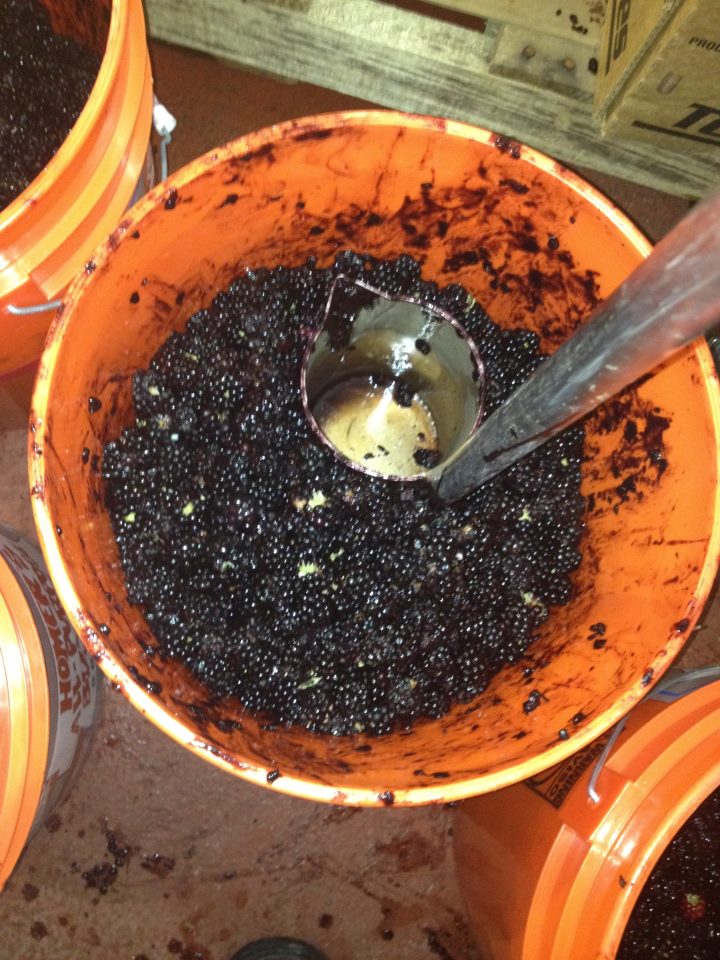
With the blackberries, they were pretty easy. We got them fresh and crushed them in a 5 gallon bucket with a stainless scoop. They were never frozen. None of our fruit is ever frozen. We added it to a stainless steel tank that was clean, ready to go. Then we racked the barrels that had already been in oak for at least a year on top the fruit and let it ferment in stainless steel for another three months.
It was the same process for the apricots and peaches. We got those fresh from our farmer. Those were both organic fruits. The peaches were the size of my fist. They were so big. Even in the most special grocery store I’ve never seen peaches this big. It was unbelievable. And this was all based on relationships that we’d built with these farmers, so they gave us their freshest, favorite fruit.
I mean, I had no idea. When we went out to the Western Slope and said “We want peaches,” they’re said, “What kind?” We said, “I don’t know, good ones,” and everybody just laughed at us because they’ve got dozens and dozens of varieties of peaches. This would be like going to Yakima, talking to a hop farmer, and saying “I want hops.” There are so many varieties, and for the farmer, they’re all so different.
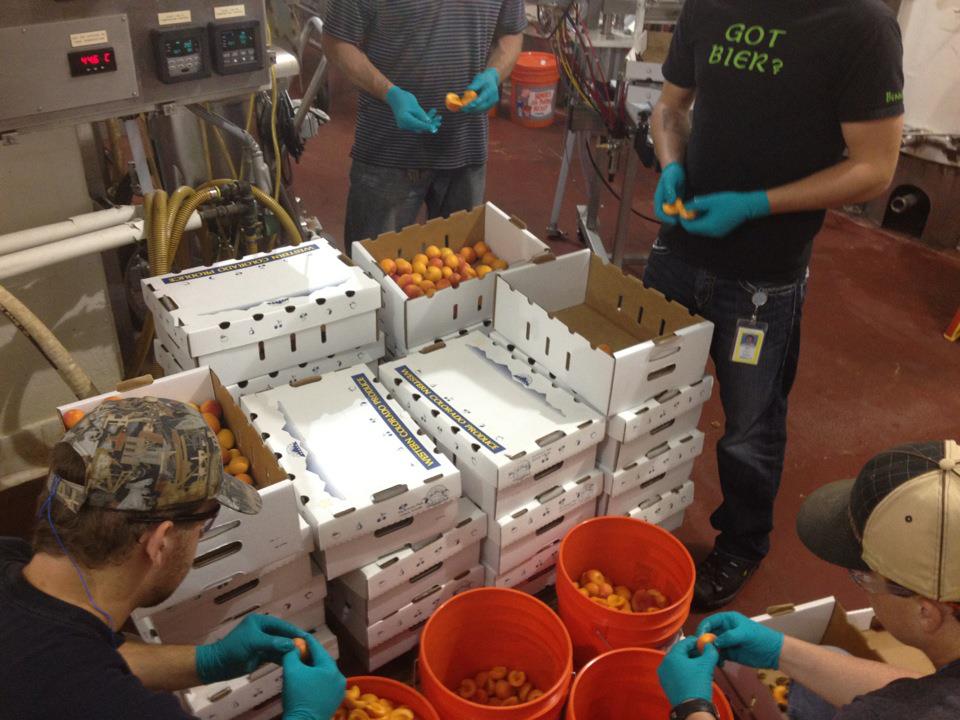
But it was just by talking with these farmers and growers that we realized that obviously they know their crop better than we do, and so we asked them, “What’s your favorite fruit? We want flavor. We don’t care about the color of the fruit… We want the flavor of it.” And that’s what we got. We were ready when the fruit was ripe. We had our barrels staged and ready to go. In the case of the apricot and the peaches, we got the fruit in and went to work. We cut the peaches into slices – took the stone out, put them into our stainless steel tank, and racked the beer on top of that. Same thing with the apricots. Those were actually easier, because you could just rip them in half.
That’s the beer. We made blends from our different barrels, our library if you will, of beers we had available. We chose the barrels we wanted to go onto which fruit, because the apricots and the peaches came at the same time and so we chose what we wanted to go with what. That was a cool learning experience, because apricots are much more sour than peaches. Our least acidic, but obviously still flavorful beer went to the apricots, and our most sour but also flavorful barrels went to the peaches. But even still, the Apricot – I don’t know if you’d agree – the Apricot is much more sour than the Peche.
ETF: Oh yeah, I would totally agree with that.
TROY: So basically what we do is ferment our base beer in stainless steel using lager yeast. It’s very simple, it’s somewhere 60% to 70% pale malt, 30% to 40% malted wheat. So we use malted wheat, not raw wheat. It’s very low hops. Probably less than 5 IBUs. We’ll ferment it according to whatever yeast strain we’re using. We mostly use lager yeast. As you might have guessed, we’ve got a lot of that laying around, so we use that.
We’ll then crop the yeast, crash it for a couple days and let the yeast settle out as much as we can, and then we’ll put it into barrels. At that point, we will either do one of two different programs: either store-bought or I guess. I haven’t thought of a good word for non-store-bought. The store-bought is where we’ll add brett and add lacto and pedio in some sort of combination. But the non-store-bought way is to add starter culture from one of our favorite barrels. We inoculate the barrel with one of our other favorite barrels.
In the case of last year, we picked our favorite barrels to go onto the apricots or
Apricots being prepared
the peaches, but we also knew that we didn’t want to just lose that culture by just giving it all up to these beers. We saved a small amount of our favorite barrels, sacrificing some beer, to go into future generations and propagate that way. From that regard, we’re probably talking anywhere from 5% to 10% of the volume of the barrel was from that previous batch, which is what allowed it to sour. We didn’t add anything else to it, just that starter culture, and let it go to create much of the same flavors that we loved so much from the year before.
So for us, having done this starting in 2009, we’ve only had a chance to do it once or twice. This year we’ll have much more, two or three different turnovers in the barrel, within these two or three generations of these barrels. Our turnover is around a year, and it’s kind of been built like that out of necessity for the fruit harvest. All of our barrels over time have started to become of age in the summer, just when the fruits are coming out as well. So we’re very lucky in that regard.
ETF: I was curious about wild Colorado yeasts, your thoughts on incorporating some into the beers. I guess you’re getting probably, on a tiny level, some in there – but what about something noticeable in there?
TROY: We’ve never tried anything truly spontaneous. We’re in the heart of the Golden Brewery, and so I don’t know how much of anything viable or desirable would be there. So for us, as wild as it gets is when we have the fresh fruit. It’s always organic fruit, and it goes in whole. Whatever is on that fruit is going into the beer.
When we add the fruit to the beer – the beer’s already been aged in an oak barrel for about a year – it gets aged for another two to three months. No more than three months for us. We’ve never found beneficial results of doing it longer than that. So that’s about as wild as it gets. Everything else is controlled.
When we get a brand new oak barrel we clean the hell out of it. Even if it has been at a winery and picked up some brett, we don’t want that. I know that gets a lot of brewers excited when they can buy pre-inoculated barrels. I really don’t like that because in wild beer brewing, you have such little control to begin with and I want to have as much control at the beginning as I possibly can. I know as soon as I put it in the barrel, it’s out of my hands.
We hot water rinse every barrel at about 180 degrees Fahrenheit; we purge it with the CO2. We do everything we can to make sure that anything that was in the barrel is out of it by the time we put our beer in. We’ve done it for a few years now, we’re by no means experts at making sour beer, but we know what we like. We want our bugs to get to work. That’s what we want to be in there, that’s what we want to be fermenting in that barrel. We don’t want it to be something that came from the winery. I want to know what it is, at least to some level. I want to know that when I added brett to the barrel, that’s what’s doing a lot of work right now. Again, by no means do I believe that I can have 100% control of what’s in there; I just want to have a fighting chance.
***This is the end of Part 1. I’ll post Part 2 next week which has a ton of great information on barrel temps, microbe addition time frames, fruit addition time frames, homebrewing advice and more!***
Here I go again with the TV show ties…The title is a reference to a song by The Rebirth Brass Band most recently used in the show Treme‘ and one I heard live during a recent New Orleans trip. Well I do feel like Funkin’ it up! I hope you do too because….. Here is the official announcement that on May 5th at Yazoo Brewing Company we are hosting a Funk Fest! We will feature multiple beers from our Embrace The Funk series plus a bunch of other funky/wild beers I was directly involved in selecting (even some selections from brewery friends of the blog!).
As many of you know one of the main purposes of this website is to help educate and attempt to show how wonderful these beer styles can be. So myself and Neil McCormick who is the “Beer Evangelist” at Yazoo have worked on an awesome line up that runs from one end of Funk to the other end of Sour!
Come Embrace The Funk and enjoy funky cheeses from local Artisan Cheesemakers “The Bloomy Rind” while a DJ spins the vinyl funk! Tickets are very limited, 200 available here. These tickets will sell out, so please don’t miss out! This is going to be a lot of fun!
NB’s “Oscar” pumped into the blending tank
Now onto the other exciting news. A few months ago New Belgium approached us about creating a special beer for Memphis Craft Beer Week. As a fan of their sour beer work and interviewing Lauren Salazar last year I was pumped about working with her on this project. It began with a few emails between Lauren, Linus and me with ideas on what styles we could bring together and what we were hoping to achieve. Once we nailed down the target beer this project really kicked into gear.
For our portion of this beer we brewed a white wheat and pale malt base beer mashed at 154F which was 100% fermented with 2 variants of Brettanomyces. The breakdown of the Brett blend is 75% B. Lambicus and 25% of a proprietary Brett pitched at 72F which self rose to 74F. We achieved 89% attenuation within 14 days of pitching into the stainless conical.
Yazoo Portion Of The Blend – 100% Brett w/ Blackberries and Currants
We chose to fruit the beer with Currants and Blackberries. I felt like those fruits would go well with the characteristics Brettanomyces Lambicus gives (think cherry pie/dark fruit). Looking at our portion of the beer it is a crazy neon pink/purple color. Pictures simply don’t do it justice.
Once our beer hit a stable gravity and we liked the flavor/aroma, it was time to blend…New Belgium sent us “Oscar” directly out of Foeder #2. For those who don’t know, Oscar is their dark sour base beer they use to build LaFolie blends and as an ingredient in some of their other Lips of Faith beers.
The resulting collaboration between Yazoo and New Belgium is named “Rufus“… dry, wild, tart, dark fruit forward with a solid sour backbone and slight caramel malt finish.
The beer will first release in Memphis throughout the week at these locations. A Nashville release will follow. As of right now there are no plans for a bottling run so this beer will be draft only in Tennessee.
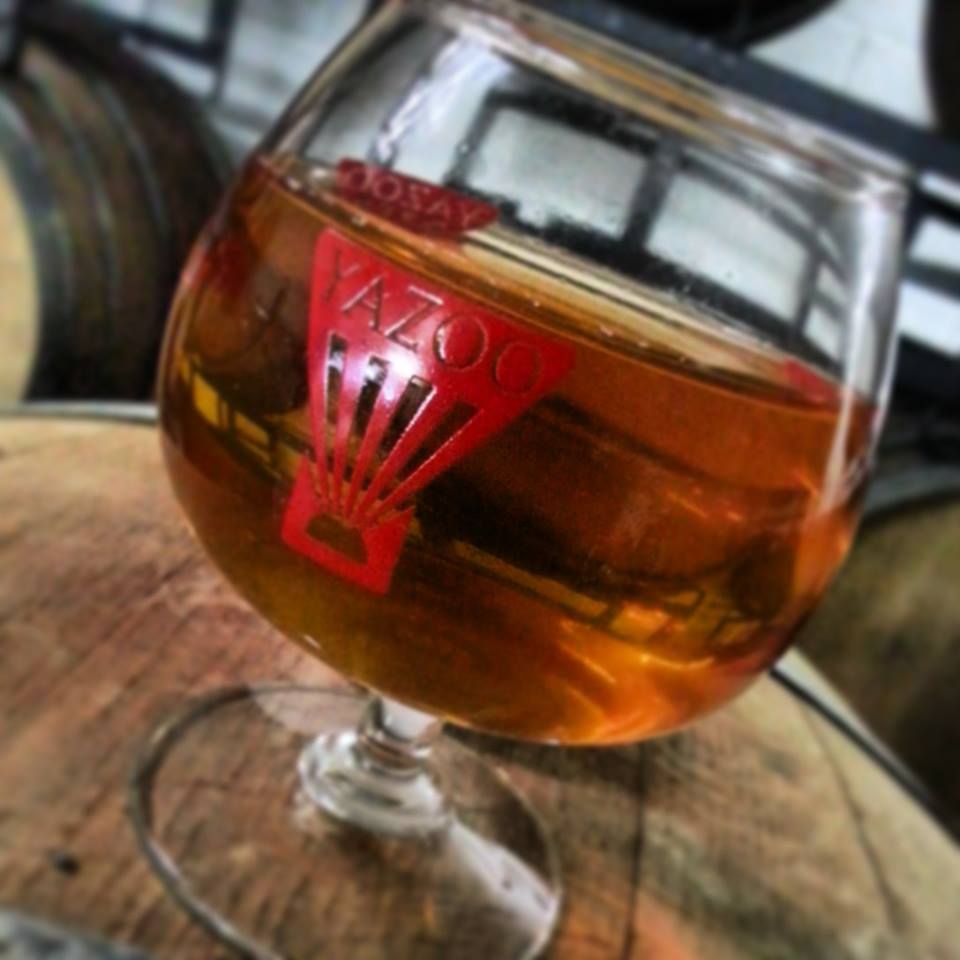 One of the things I enjoy the most in homebrewing is experimenting with different yeasts and bacterias. I’ve said it before that when I was brewing a lot at home and entering competitions I felt like using blends of strains or the latest limited yeast release was key in my wins. Some brewers love getting that new hop variety everyone wants this year…others love trying new fermentable sugar, but for me it’s always been about the microbes.
 excited about the ones we will release this Sunday at Funk Fest. Back in January my buddy Dmitri (who I’ve known for a few years through homebrewing boards and runs this awesome website) sent me samples of Brettanomyces he had isolated from a bottle of Cantiilon Iris. He was able to identify 3 different Bretts in the 2007 Iris. In chatting with him they all sounded like familiar descriptions of the flavor layers I love in Cantillon, so I was more than excited to kick off batches with these Bretts!










 Embrace The Funk