I wanted to give you a quick update and overview about what’s coming up on the website. I’m still doing the brewer Q&A’s and have an awesome one with Troy Casey who is a brewer at AC Golden…in their sour and barrel program. Yes AC Golden has a very nice sour and wild beer program. It’s a rather lengthy interview (which is great for everyone), because trust me…he knows his stuff.
I’ve had a few people ask me about my home brewing setup. They would like to see a detailed post about my equipment and work flow. Well I took some pictures of my setup the last time I brewed which was in December (GASP! That’s way too long), but I decided to upgrade my mash tun. So I’m in the process of building a new manifold for the larger tun. I’m aiming to brew a batch within 2-3 weeks so I should have a picture heavy post up shortly after that brew session.
The PH of commercial beers section of site will see a major increase in readings within the next week. I have close to 30 new readings to give to you…including Russian River Deviation, New Belgium Twisted Spoke and Lost Abbey Duck Duck Gooze. There were some very surprising readings on a few of the beers which has inspired me to dive deeper into the acidity levels of sours/wilds.
Are any of you going to be at SAVOR this year? I will be there with Yazoo and have 2 funky offerings for the event. I’d love to meet up with some of the readers of this site while I’m at the event. Also if you have any bottle shop suggestions please let me know…Thank goodness Southwest Airlines lets us take 2 bags!
And finally…I’ll have another post up within the next 48 hours with some really exciting news about the Yazoo Embrace The Funk Series. It will also include the complete info on my sour collaboration with New Belgium which releases in 2 weeks.
I’ve been looking forward to the day when I had the chance to write this blog entry…the day I get to talk about brewing a full size batch of sour goodness for the Embrace The Funk series at Yazoo. Yep on March 2nd Linus Hall and I brewed a full 40bbl batch on the big system! (Our previous batches together have been 10bbl) What an awesome experience it was to plan and gather up everything we needed to brew a Lambic style ale.
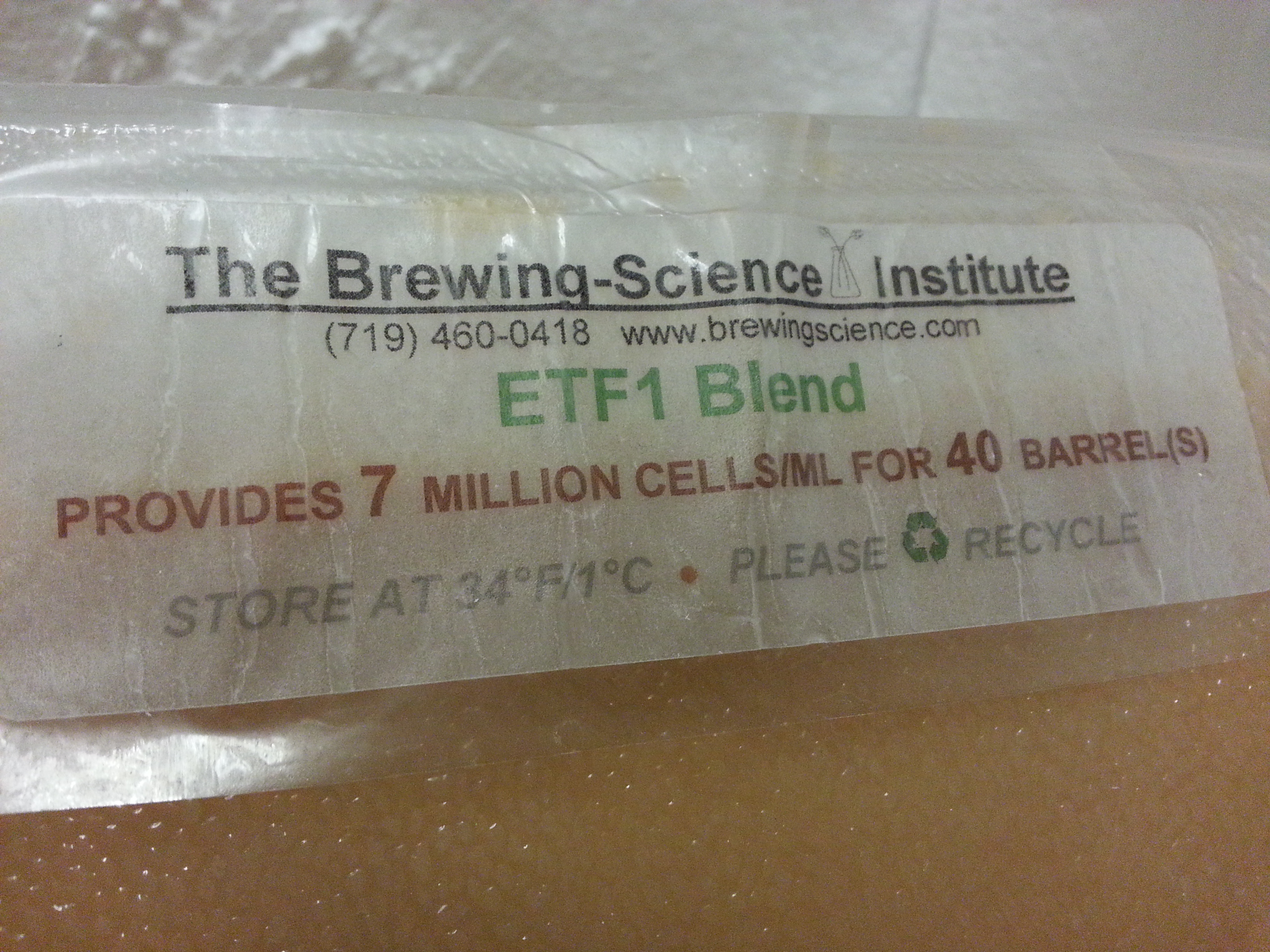
One of the first items on the list was to figure out which yeast/wild yeast/bacteria blend to go with. We already have a single barrel batch (59 gallons) of Lambic style beer fermenting which we have been very happy with it’s progress since early Fall. That batch was fermented with a few goodies from my stockpile of funk and Bug Farm 5. So in what has been one of the coolest moments of my sour brewing adventure I worked with the Brewing Science Institute (BSI) on building up a proprietary sour blend based on our first batch. Working out the proportions of the different microbes to make up our ETF1 blend and actually seeing 40bbl pitch of it was one of those brewing moments I’ll always remember.
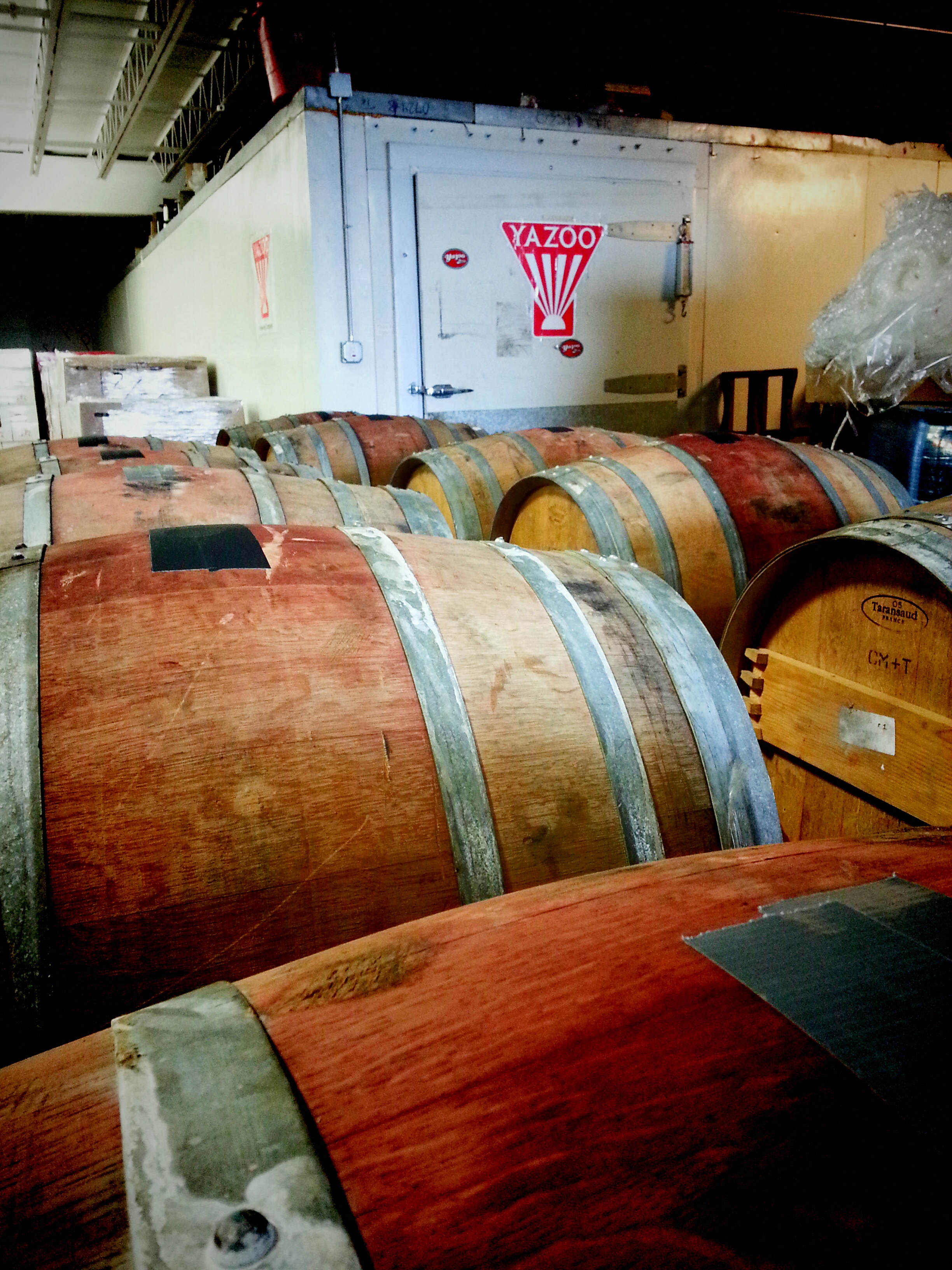
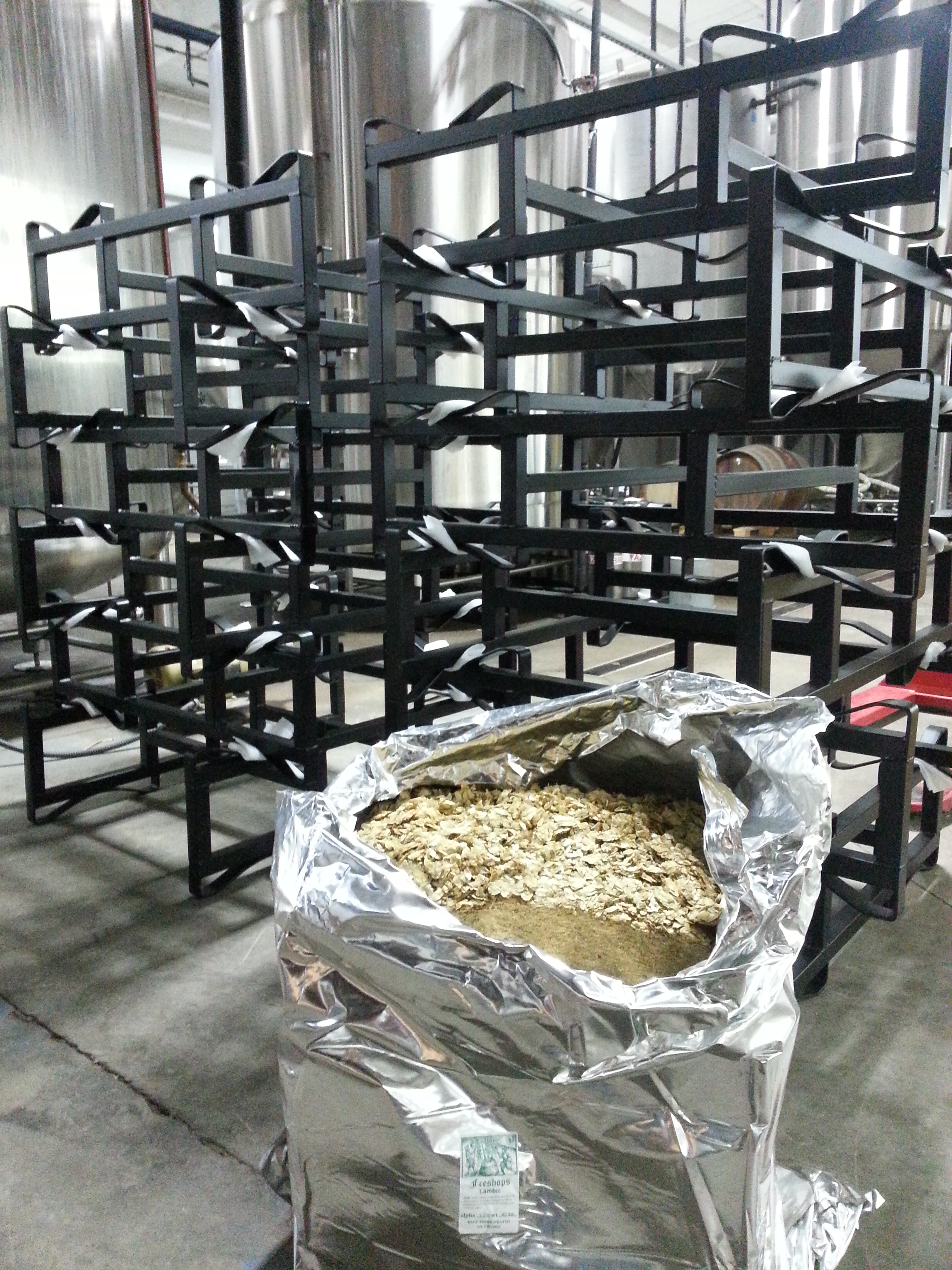
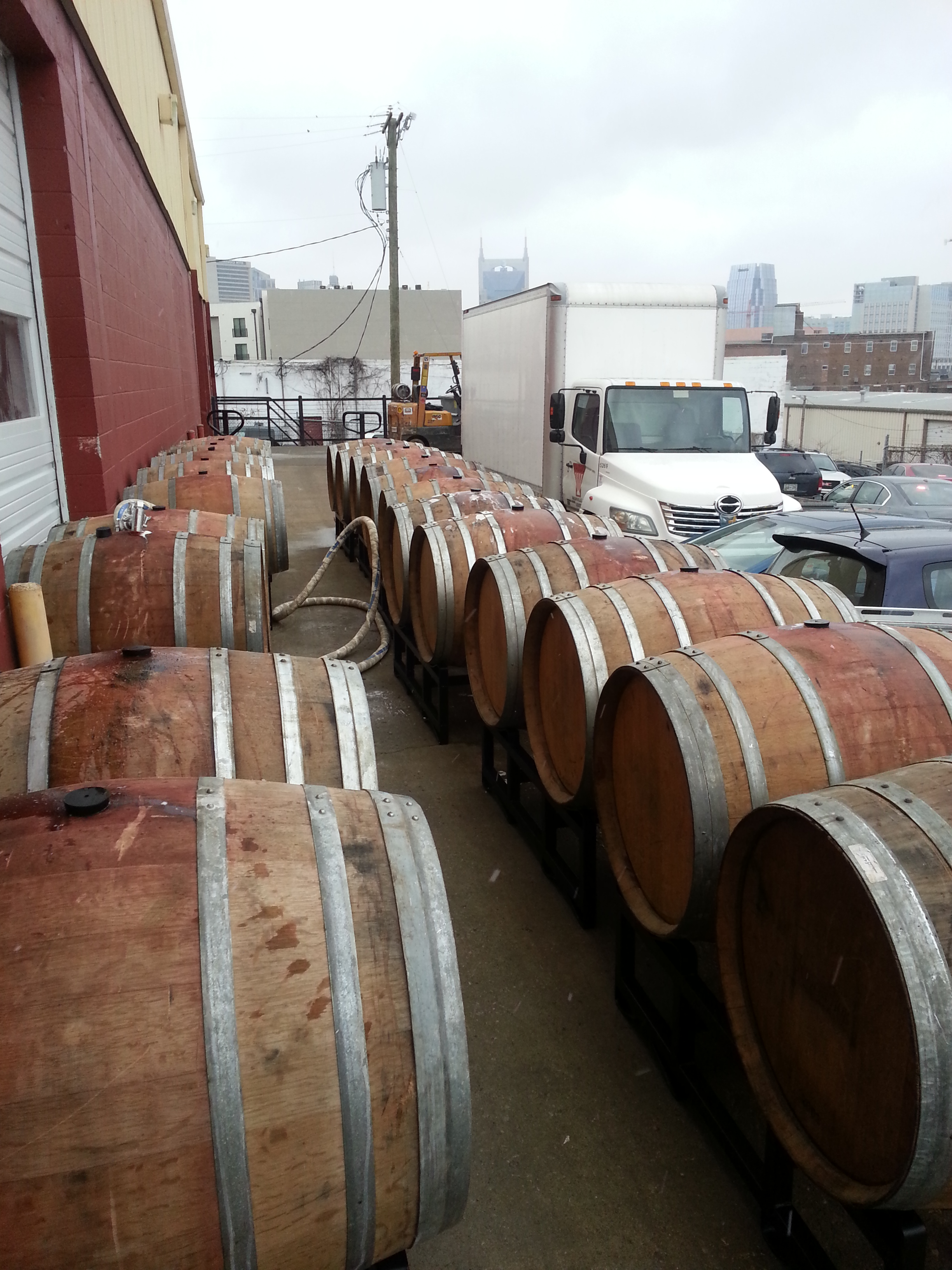
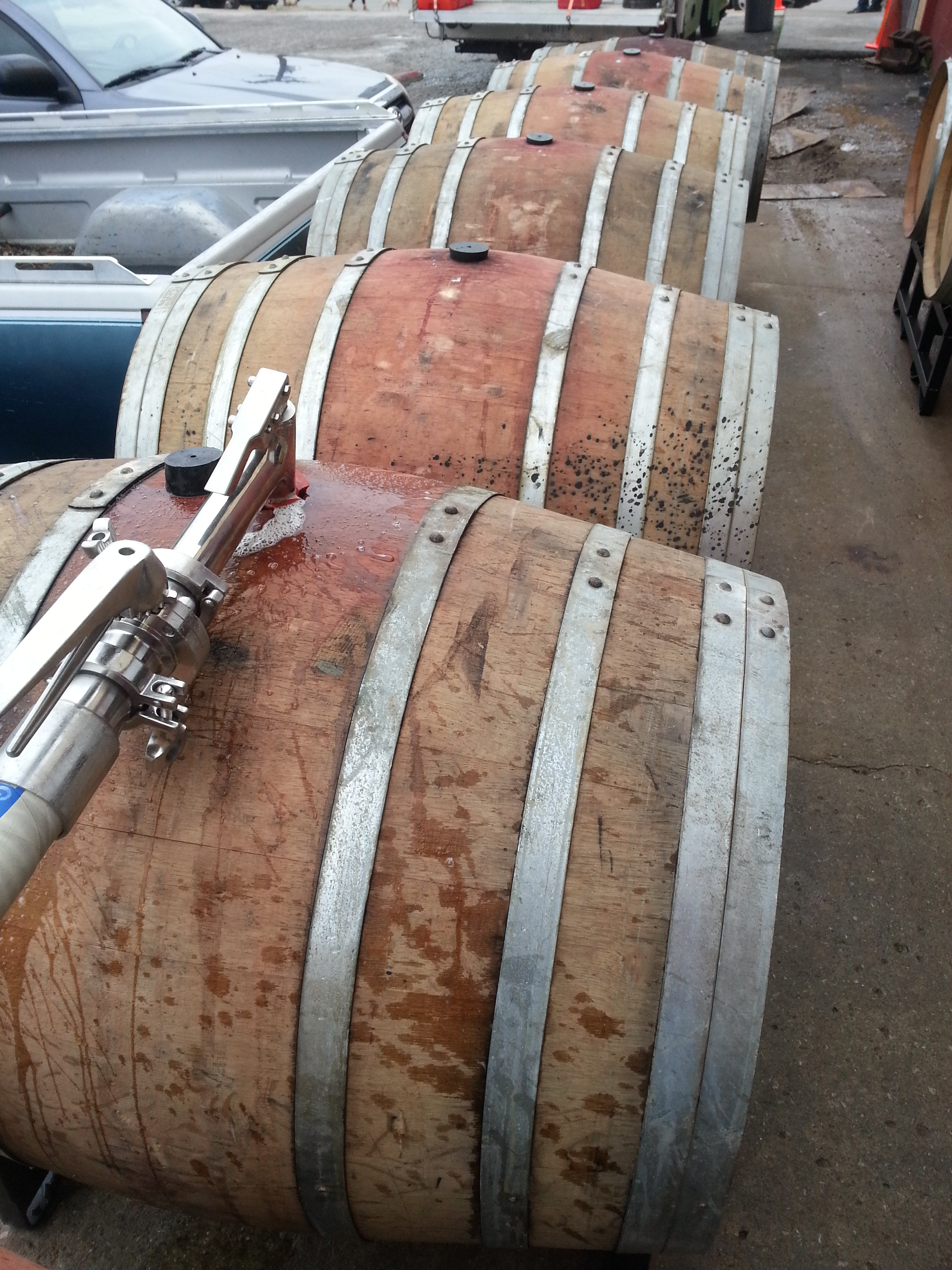
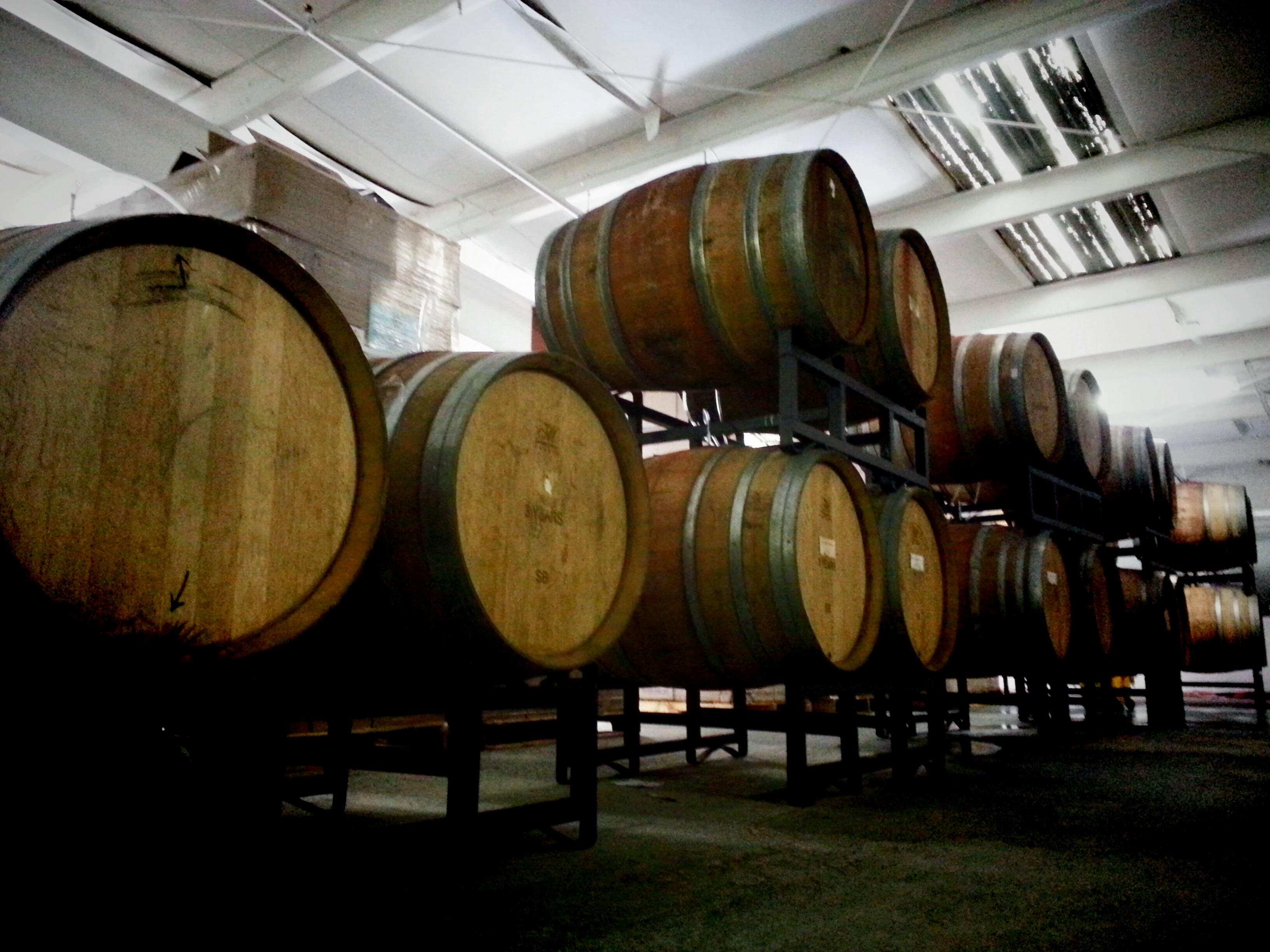
We decided to go with the same barrel broker as we previously used to secure our racks and wine barrels. We secured 23 neutral French Oak barrels for this project. A few days before the brew session Linus filled and swelled each one to check for leaks. We only had one barrel that leaked hot water from the area where the Head meets the Croze, but it swelled back out after a few hours. As we did on our previous batches we opted for used 7 inch double barrel racks which allow us plenty of working room near the bung hole. The were pretty rough when we got them, but a quick sandblast and powder coating by one of the local paint shops fixed that problem. They looked sweet when we got them back! Since this batch is going sit and rest for quite awhile we thought it would be nice if the racks looked good.
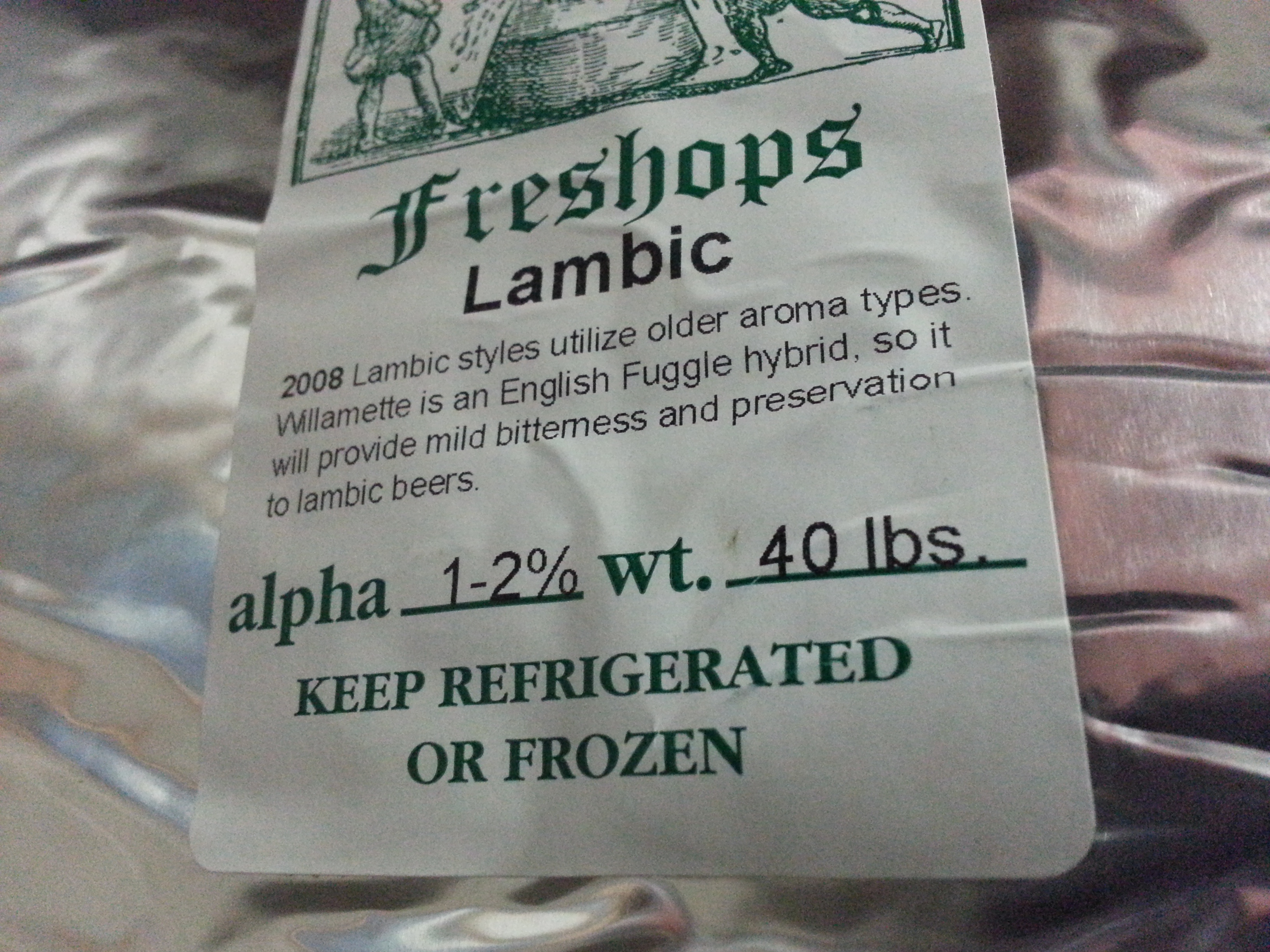
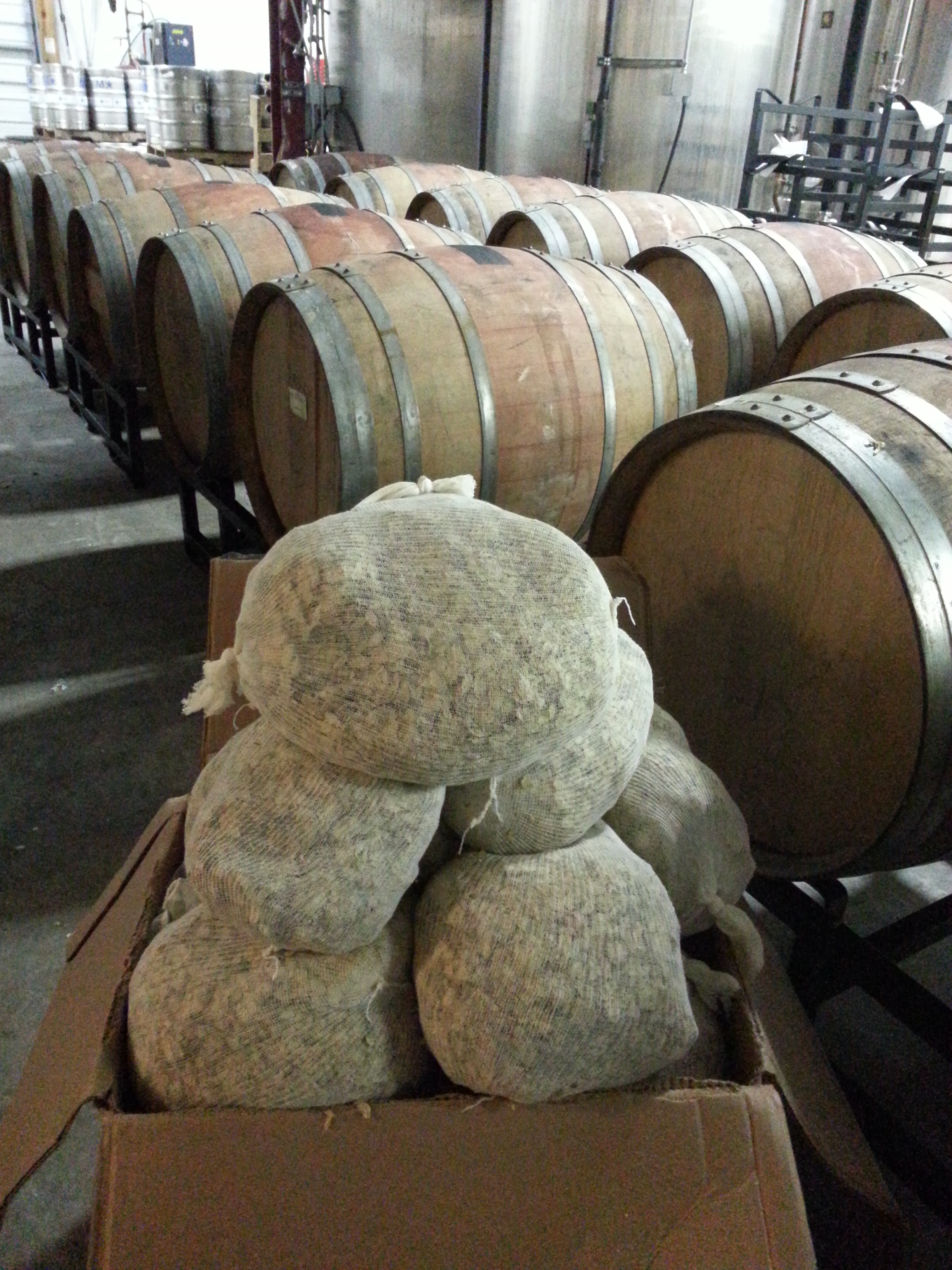
So as you can see in the picture above the racks look awesome…but also in the pic are the hops we used. Those are 3 year old aged whole leaf Willamettes from Fresh Hops. Ironic getting aged hops from a hop farm called Fresh Hops right? I used these same hops at home a few months ago when I brewed my Lambic style beer for the year and have been really pleased with how the aged hop profile came through.
This was really the only part of the brew I wasn’t 100% sure about. When I’ve used aged hops at home (whether they were sourced from a grower already aged or ones I aged in my attic) I know what my hop extraction is like on my system, but definitely had to yield to Linus’ knowledge of his system on this one. My typical home usage rate of what equates to 1/2 a pound per bbl volume of beer is close to what Cantillon uses… by the way I’m told that Drie Fonteinen uses about 1lb per barrel.
So once Linus and I talked about the hop addition time and what to expect I decided on .65 pounds of aged hops per bbl at boil. Due the induction type boil system at Yazoo all the whole leaf hops had to be bagged up or they would get sucked up and clog the system. I’m happy to report that did not happen!
So after a soft water single infusion mash at 154F with a grist containing 60% Pils/ 35% White Wheat/ 5% Acid malt, boiling for an hour, chatting with Brewmaster Spike from Terrapin Brewing Company who stopped by (and brought us beer!) we were ready to knock out and fill barrels. The barrels were lined up outside on the loading dock and wouldn’t you know it…Mother Nature decided we needed snow flurries which definitely made the brew day even more memorable!
We filled the barrels and pitched @70F our super fresh ETF1 blend at a rate of 7 million cells/ml.
Active fermentation really kicked off later the next day…It was time to break out the mop to clean around the barrels by Monday morning.
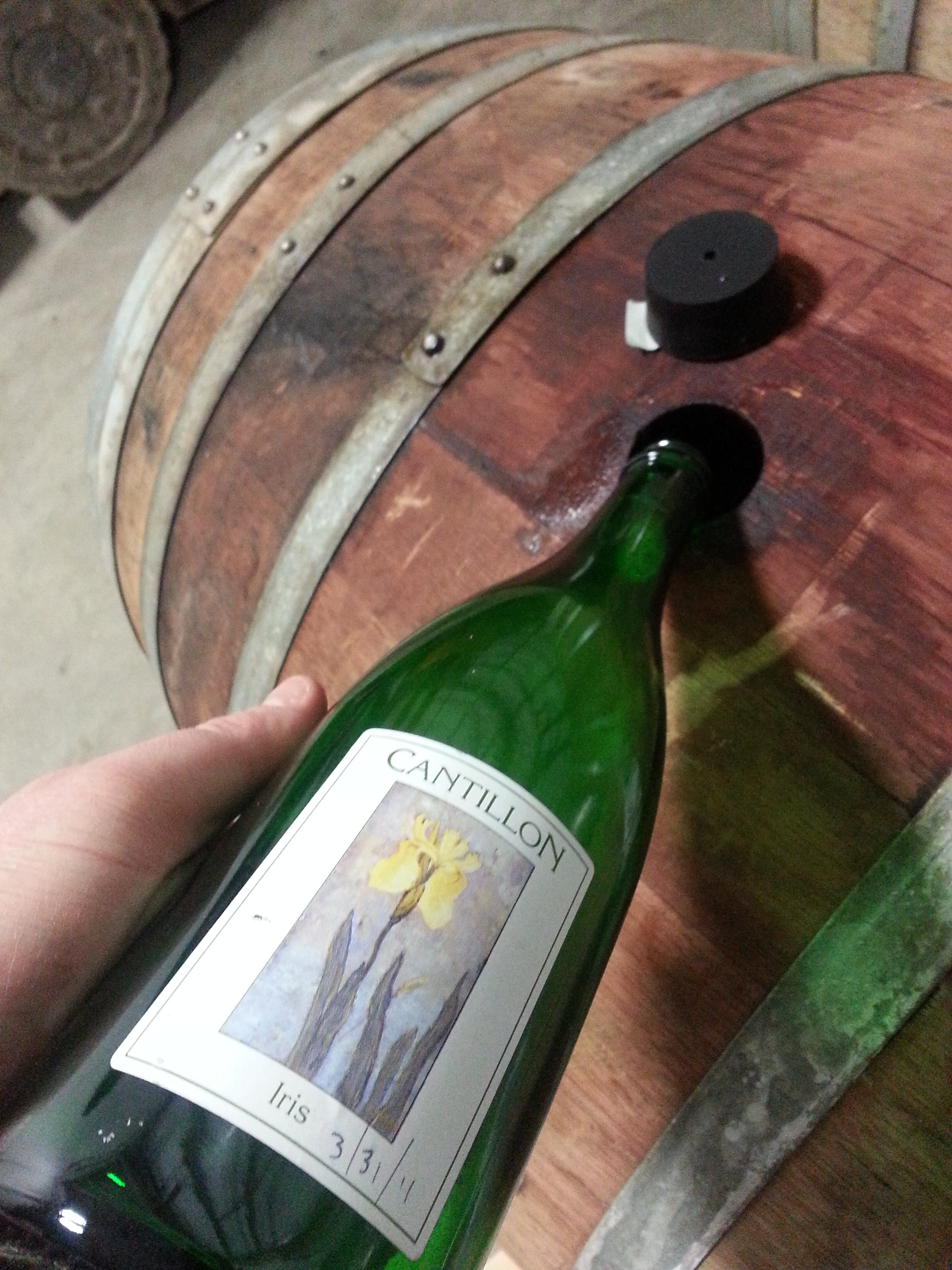
We did give a toast to someone who has been very helpful to me over the past 2 years and given me some great Lambic brewing advice: Jean Van Roy of Cantillon. So since I’m not a champagne drinker and this isn’t a boat… we christened one of the barrels with the yeast/bacteria dregs from our toast bottle of Cantillon Iris and marked the barrel J.V.R. Maybe that barrel will have some extra magic to it? Who knows? I just thought it was something fun and respectful to do with the dregs.
Even as I write this blog post I’m still smiling and almost feel like I need to pinch myself. I had so much fun planning the brew and brewing with Linus this past weekend. I still can’t believe I’m getting the opportunity to create sour/wild beers for you guys at such an awesome brewery. I’m looking forward to continuing to collect data and experiences to share with everyone.
I’ve had a lot of people ask when they can start buying our Yazoo Embrace The Funk series of beers. I think in just a couple of weeks (2-3?) I’ll be able to release the second beer in the series (first was Wild Child in December). We have been working since last year on these beers and I feel like in about 2-3 weeks I’ll have enough beer that is already kegged and enough that is soon to be kegged to start releasing. I have to make sure this is OK and will fall in line with the taproom’s tap schedule, but that’s what I’m shooting for. The Sour Red we brewed back in November continues to age and rest in wine barrels. A few people have recently asked how that project was going…
So that’s what I did with my Saturday, I hope yours was just as awesome!
As always whenever there is something worth updating on this beer I will do it it here and make sure to Facebook/Tweet it out.
Which brings me to this: Make sure you follow Embrace The Funk on Twitter and Facebook. Don’t miss the line of ETF recipe kits available exclusively at Rebel Brewer.
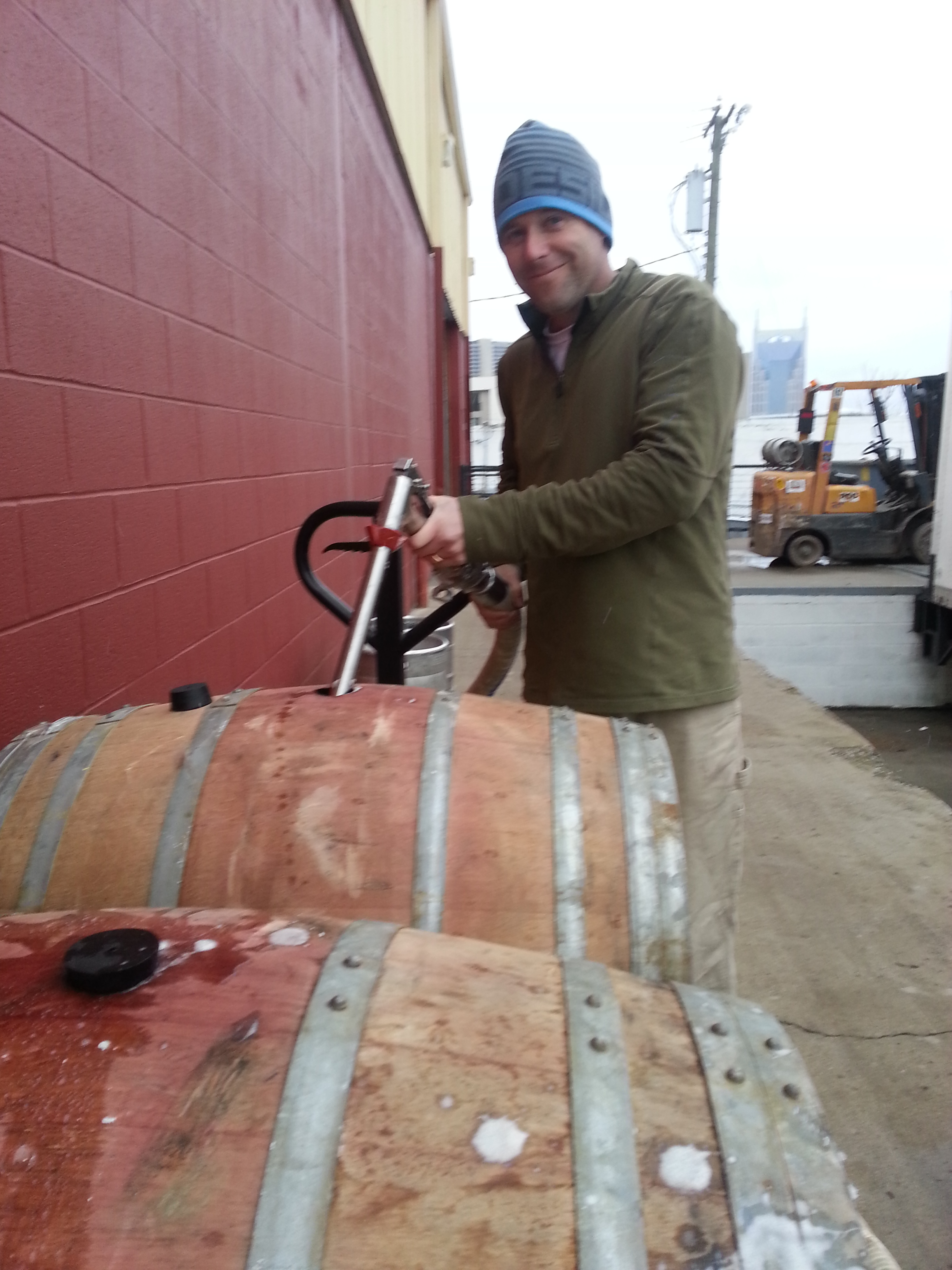
Here are a few more pictures from our brew session Saturday:
Linus filling a barrelBarrel GunOur Lambic Style beer fermenting away in the funky upstairs area 3/4/2013
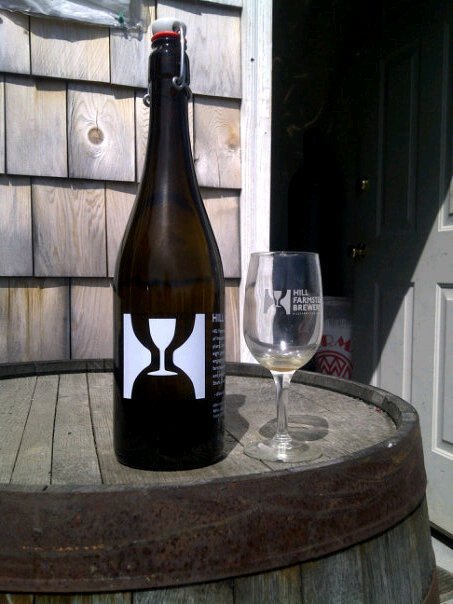
About a week ago Shaun Hill of Hill Farmstead Brewery shocked many beer lovers by announcing an upcoming membership sale. The owner of the recently awarded RateBeer #1 Brewery In The World gave Embrace The Funk a few details about the program and how you can get access to some of the great sour/wild beers in his line-up.
ETF- What is the official name of the membership club?
Shaun- “Hill Farmstead’s Collected Works”
ETF- If you’ve come up with a “Trustee” pick up policy, can you give some info on it?
Shaun- Of course. Given our location – we absolutely must allow for ‘trustees’ to assist in beer retrieval. Members can name their trustee, with proper communication, until a few days before the beer needs to be retrieved. We will hold onto the beer, in a refrigerated storage space, until July 6th and 7th. After those days… the beer will go up for sale. Folks shouldn’t sign up if they don’t have a means of on site retrieval.
Bob Montgomery Images
ETF-Will all the memberships be sold online or will there be some sold locally?
Shaun- At the moment, it looks like 25% on site, 75% online.
ETF- Will the membership include any special glassware for members only?
Shaun- Yes. Members will receive 4 new branded tasting glasses… Spiegelau 13oz wine glasses.
ETF- Your beers seem to have no problems selling, so how did you come to decide to create a membership?
Shaun- Our location. Customers are driving many, many hours in order to retrieve bottles of our limited releases. We figured we would do our best to “reserve” some of these bottles for these loyal customers – and save them 20+ hours worth of round trip driving and expenses.
ETF- Your beers are in high demand and have a limited distribution. Thoughts on the hope the memberships will spread the beers around?
Shaun- Honestly, I have no idea. I am not sure if the beers will be shared, hoarded, cellared, resold…
Bob Montgomery Images
ETF- This is probably like asking who a person’s favorite child or pet is…but which one of the member releases are you most excited about?
Shaun- None of the releases, as of right now, are member only. All of these bottles will also be hitting shelves, in some capacity, in our retail shop. The membership is geared toward those that are never certain of their ability to drive long distances to retrieve bottles… As of right now – there is no favorite. These are among some of the best beers that I have ever tasted in my life – Double Barrel Damon, the Flanders Red, Satsuma Flora…
ETF- So just to clarify and me not mislead anyone, membership will include a certain amount of some of the bottles you listed on the “Bottle Release” page and no “Members Only” beers?
Shaun- There are no “Members ONLY” releases. With only 150 members – those would be very small releases and would require a significant amount of work for such a small group of folks. Maybe someday. This is a “reservation” group in the most inherent sense of the word. We are holding back bottles for people…to guarantee that they have an opportunity to try them. Members receive 12 bottles total, 1 from each of 12 different releases. I think cost will be $400.
ETF- Are the membership sales going to any particular project you have in mind?
Shaun- A new keg washer/filler that we just purchased from Lambrechts in Belgium. This will allow us to grow from 1,800 barrels of production to 3,000 barrels of production in a healthy, happy, and time efficient manner.
ETF- If all goes well the first year, is it likely the second year see an increase in available memberships?
Shaun- If we are able to construct our new barrel cellar/storage facility as part of our upcoming expansion, yes. We will be able to increase the barrel aging project – and hopefully increase Collected Works memberships by 100% (from 150 to 300 members). We hope that we will be able to push through legislation (here in Vermont) that would allow us to ship our beers to consumers in certain States – thus opening the possibility for a slightly expanded reach of memberships.
Shaun will be releasing the full details and membership sales soon. So stay tuned to their page for the complete details on exactly what all is included in the membership we didn’t cover here. There is more he will reveal soon….
I hope everyone’s New Year is going awesome so far. It seems like things have gotten busier for me after the holidays, but wow it’s a good and fun type of busy. In November I wrote about the Embrace The Funk Series by Yazoo. The project is coming along nicely with the beers Linus and I started progressing as I would expect at this point. (Side note- even on days when I’m topping off a barrel or cleaning a barrel I still can’t believe what a cool opportunity I’ve been afforded!)
So….with things fairly under control and something to talk about… I thought an update on the Yazoo front and my home brewing front was in order.
I currently have 8 different sour or wild beers fermenting at Yazoo. Last week we shot an interview with Beer Street Journal about our sour project (I’m told it should be up in the next week and be about 2 minutes). In that interview we revealed in November Linus and I had brewed a 10bbl batch of Flanders Red based on one of my recipes. The beer is being aged in 2007 Cabernet Sauvignon barrels and fermented with a custom microbe blend based on the blend I’ve had a lot of success with at home. It was pretty cool to see that blend built up as a 10bbl pitch from the lab! Release date is still very much “TBA”, but it could be around December 2013.
When Linus and I were talking about how I wanted to build this program, I knew I wanted it to be built around Lambic or I guess American Wild Ale as we should call it here. Lambic and Flanders Brown have always been my 2 favorite funky styles. You can build so many great beers styles from a good batch of Lambic styled beer, so it just makes sense. So we do in fact have a 100% barrel fermented Lambic styled beer going… 2bbls to be exact. Why a smaller amount than the others I have going? Well the bug blend I wanted to use was only available in a 1bbl pitch size, so we did have to do a little lab work and propagate it up to a 2bbl pitch. I’m happy to report that blend (we worked with Al at East Coast Yeast to build the initial pitch for us) is making some crazy funky beer in Nashville and we are proceeding with brewing a bigger batch. Initial sensory on this batch is giving some awesome flavors and aromas.
Now I get to talk about a batch I’ve always wanted to do, but just didn’t have the equipment to do it until now: 100% spontaneously inoculated wild ale. In December Yazoo installed two new 200bl fermenting tanks. They were so big that a section of the roof had to be temporarily removed so a crane could lower the tanks into place. The roof was open for a few days before the tanks arrived and as you can see in the pictures we had gorgeous cool weather for those days and the installation day. Now the area I work in is upstairs and being fairly close to that opening… combined with cooler, but not cold weather I knew it was time to go totally wild. I transported the hot wort upstairs to a large container (temp was around 140F) and left it open for 25 hours to cool and collect microbes then transferred into the fermentor. My main concern was making sure I didn’t have too much wort depth in the container. I tried to eyeball about 4-5 inches of worth depth, any more and I was concerned I wouldn’t collect enough microbes to ferment the total volume of wort. Was that the right call? At this point I’m not 100% sure, but the batch did kick off with active fermentation within 48 hours of hitting the “coolship” (for lack of a better term at this point). I haven’t done any lab work on this batch yet, but I hope to post some pictures on my Facebook page next week. It smells really funky at 5 weeks old…is that good or bad? I’ll let you know soon.
That’s what we have going at Yazoo right now, I’ll talk about how the other batches are progressing in a future post. Linus and I have laid out the brewing plans for 2013, with some really neat styles being produced. Right now we are in the process of acquiring more barrels…some of which should arrive next week. I’m continuing to collect different non-commercially available variants of Brettanomyces and bacterias to hopefully produce some really cool test batch beers for the taproom.
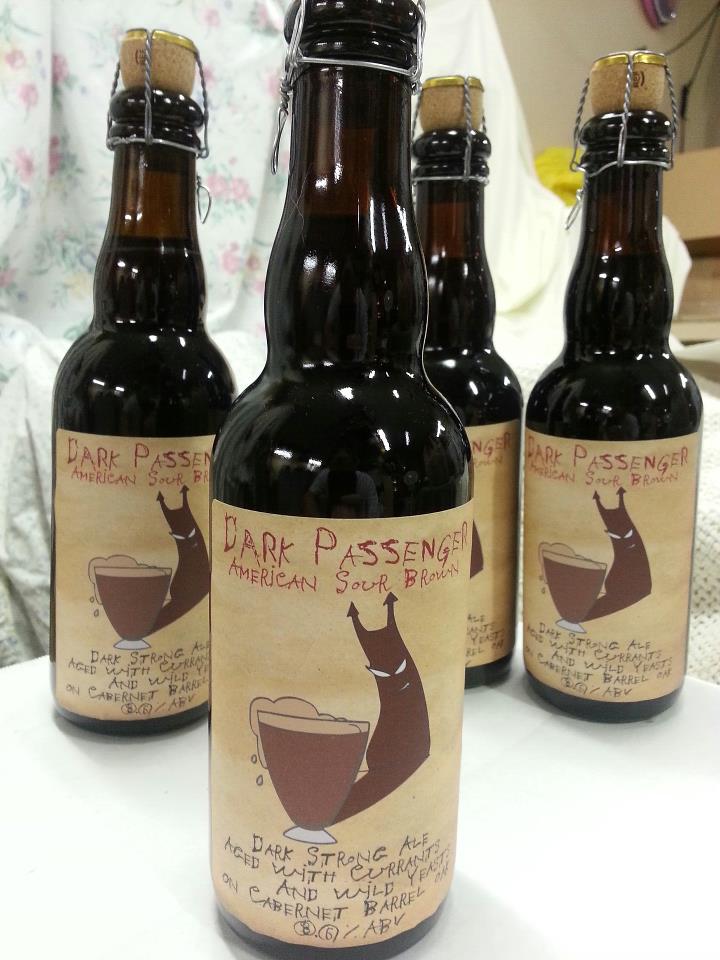
Batch 1 bottles
Now onto the home brewing! I recently brewed another batch of The Dark Passenger with a few changes. I was really happy with the way batch 1 turned out, but wanted to see how a little more malt and a higher gravity tasted in this recipe. I’ve since upgraded my mash tun to a larger size, but I had to use some DME in this recipe since my previous mash tun wouldn’t hold the volume of grain.
Original Gravity: 1.075
Bitterness: 11.8
Mash 154F – 60.0 min
(62.4%) Pale Ale Malt
(11.0%) Vienna Malt
(3.7%) German CaraMunich III
(3.7%) Golden Naked Oats
(2.8%) Special B Malt
(1.8%) Carafa® TYPE III
(11.0%) Dry Light Malt Extract – added during boil
East Kent Goldings (5.6%) – boiled 45.0 min
2.0 lb (3.7%) D-180 Belgian Candi Syrup – added during Whirlpool
Wyeast 3787 until 1.040 then the Bretts and Bacterias were added.
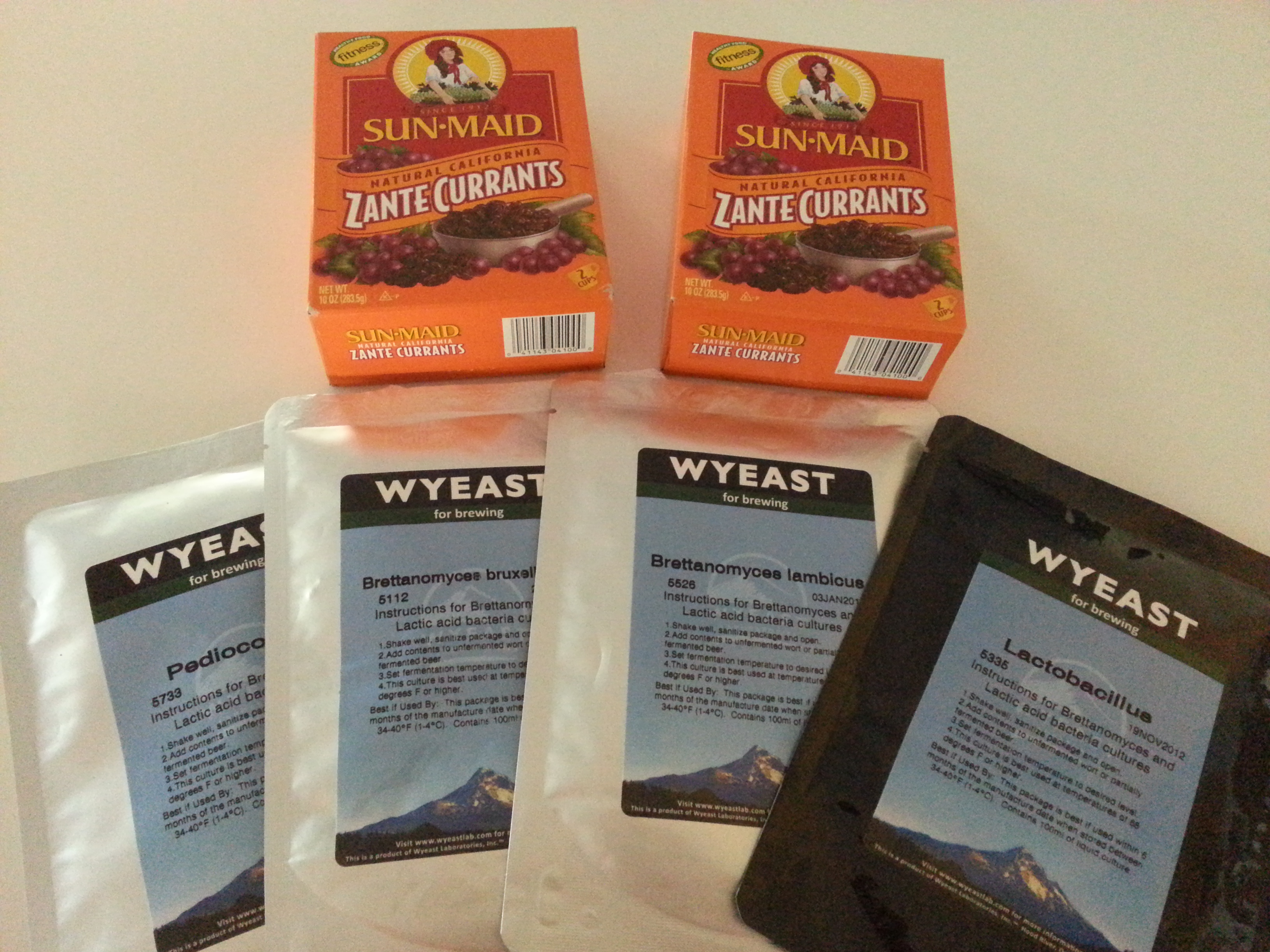
Once again I went with dried currants, but added them at 1.035 instead of 1.019 like last time. The amount of currants was also slightly less at 10oz this time and 11oz on batch 1. The only reason for the smaller amount is they came in a 10z box as opposed to batch 1 when I purchased them by the ounce at Whole Foods. I really don’t think it will make much of a difference. The carboys seem to still be chugging along, I’ll do some sampling in March once they’ve had a chance to ferment for 4 months.
ETF- When you are back building a dark hoppy brett beer like Wild Wild Brett Blue, tell us about some of the things you have to consider?
Chad- So there’s basically what’s considered a dark IPA or a hoppy Porter, but to me there is still a difference in character. A Porter can be a medium to heavy body, although with a heavy body you tend think it’s more stout like. Whereas in dark IPA I’m still looking for light to medium-light body, so there is some distinction between them. The idea is to make the same exact beer you would make if you were making the IPA, but instead you are going to use a handful of dark malts.
The way I did it was taking the same recipe we had done with the IPA and bring up some of the character with a little bit of chocolate malt and Carafa II. I call it more brown than black even though it was certainly a very dark beer with a dark head.
A lot of what I’m looking for is: How do I retain all the characters of a normal IPA and just get color. But with the Brettanomyces it didn’t really work that way, the Brett really brought out those characters. So what is less than 6% of dark malts and the rest being pale malts…basically 2 row… really brought out a deep chocolate color. Not necessarily the chocolate you get out of malt, the way it really brought out the character really comes more from the Carafa II than the chocolate malt which gives those coffee like notes. So especially with using Brettanomyces in a dark beer I wouldn’t use anything that’s a roast malt, there’s just too much astringency. You have to go with a de-bittered malt like a Carafa II. I know Briess is starting to make some stuff, but I like to use Weyermann.
The Carafa malts are so nice because you get all the color you want, but the character doesn’t come through too much. The brett is really nice at bringing out some of the chocolate notes in that malt, so you get this creamy/chocolate characteristic. It’s crazy the way the brett accentuates too…I’ve had that same beer fermented with a clean strain of saccharomyces and it’s medium-light bodied, more along the lines of a light bodied porter with the same malts. Whereas in this one the brett brought out the creamy characteristic, which went well because of the Blue Spruce we used in it. You have to use something to back up that spruce/evergreen character.
ETF- You hit on this, but talk a little more about why using malts like black roasted are bad in a dark brett beer.
Carafa II
Chad- Astringency. I find beers where it’s big, chalky and has the astringent roast character. Acridness is the term for it, so the acrid roasty character is taken by the Brettanomyces and basically doubles it. That astringency character starts to come through and you just get this chalky, acrid, dryness with nothing to back it up or balance it. So when you are just trying to use roast malt with the Brettanomyces, like in a brett stout it just creates that dry and chalky acrid beer, whereas it’s very much the opposite when you use the Carafa II or these other de-bittered malts. Instead what happens is the same thing when you look at Special B and these malts that have a high kiln temperatures. You have melanoidan characteristics in the malt, that’s where the age characteristic eventually comes out in the beer, but it has to be there from the beginning. The brett instantly starts to pull out some of those dried cherry and dark fruit notes out of the malt. So what you start getting instead of a “chocolate-ness”…you get a really subtle fruity, dry, dark cherry character that’s really complimentary to the beer. That’s what I’ve found with using brett and Carafa II and even low amounts of Carafa II in a black IPA-esque beer you start to get a hint of that which is really interesting.
ETF- As far as hops go, which varieties would you suggest in a hoppy dark brett beer? Citrusy or dank? What about Cohumulone levels in the hop variety?
Chad- I would always try to take cohumulone levels in to consideration. That’s why I don’t use Magnum or any hops like those. I find them to be astringent hops. I know Magnum is a hop that many breweries love, but I prefer for bittering varieties like Cascade.
I would like to play around with hop extracts, they are a great way to keep all the plant material out, but still get really nice character. Most people probably don’t realize the best IPAs they are drinking are bittered with hop extract and that’s one of the reasons they are some the best IPAs… Beers like Pliny the Elder. There’s a brewery in San Diego called Societe, Travis use to work with Vinnie. I had their IPA recently at GABF and it’s awesome…like a Heady Topper or 3 Floyds.
But anyway…at first I thought when using Brett the more important thing was to accentuate the fruity hop characteristics because that’s what I liked so much about “that” hop. With the Wild Wild Brett Blue we were going to use Spruce and I wanted to accentuate the Spruce, so I used Centennial hops. Such a beautiful hop…it’s not overly “piney”, I find it to be more on a citrusy, green apple, orange side. I also used a lot of Chinook which also accentuates the “piney” and worked really well with the character.
I’ve now gone back with the series of beers called “Hop Savant” and all those will use different hops. Some will use Colombus, Amarillo, or Columbus and Simcoe…just to play around with the hops. I think Brett can work with a lot of hops. The important thing is not having a lot of astringency. When I’m thinking about what I might use for bittering…it’s low cohumulone hops that have a softer more delicate bitterness and are more just for flavor. Don’t buy any hops with the idea “These are a bittering hop and these are an aroma hop”. I would buy all aroma hops which just happen to be high alphas so they are thought of as a bittering hop. I don’t use hops for typical bittering, so even if I’m going to use Chinook to “bitter” with…I put them in with 15 minutes left in the boil.
ETF- Let’s talk more about the timing of hop additions in Brett beers. I tend to move most of my additions to an all late boil…but what are your thoughts on bittering units in all Brett beers?
Chad- I don’t really like very bitter beers. They are gripping on your tongue and that character stays and the beer leaves. Yeah there’s some flavor in there, but you still have this big bitterness left on your tongue and I think that’s detracting from the beer. So for me the only beers I look at IBUs are our Saisons and sour beers. I’m much more concerned about IBUs in those beers. When it comes to making the hoppy beers, they are exactly that: hoppy. So if I could have zero IBUs that’s the type of hoppy beer I want to brew. Everything is about late hops: aroma and flavor. That perception of aroma and flavor is going to give you enough bitterness to balance the beer. So certainly a beer with no hops is going to come off sweet, but if you have aroma and flavor (hops) you have something that is hard to measure: The perception of bitterness. So no matter what, even if you just dry hop a beer, it will have IBUs. Alpha Acids are slightly soluble in water and oxidized Alpha Acids are soluable as well, so to me that’s enough bitterness. I don’t know what our beers have…25 or 30 IBUs? To me that’s plenty in a hoppy beer, it’s the fact it has all the aroma and flavor the beer needs to be enjoyed.
ETF- So in the beers you are talking about what’s the hopping schedule?
Chad- In both the Wild Wild Brett Green and Blue that had a heavy hopping dosage they were 90 minute boils and no hops during the boil. As soon as I turned off the steam to the jackets on the boil kettle and started the whirlpool, that’s when the first hop additions were added. It’s all aroma hops additions, but you are still getting some IBUs. You still get utilization even at 180 degrees and we’re not getting to 180 degrees until the end of knocking out. You whirlpool for roughly 15 minutes, then rest for 10-15 minutes so that’s 30 minutes already the hops have been sitting. Knock out takes another 30-45 minutes, so from the time you’ve added the first hops they’ve been in there over an hour. So there is isomerization going on…albeit the utilization is not 30%, probably 1 %. But all the same it’s still occurring and that’s where I find more than enough bitterness for the beers we are brewing.
ETF- When you are whirlpooling what’s the temp?
Chad- So when you finish the boil, well for us in Colorado it’s 204F degrees because of the barometric pressure we boil at a lower temperature, but by the time we are whirlpooling it’s 202F. At then end of whirlpooling it’s around 198F then knock out at 195F.
ETF- So obviously not much change then…
Chad- Yeah, what’s nice about a whirlpool is once you run it through that’s another vessel taking temperature out, so now you can be down to 185F. So at 185F that’s where you are able to pull the “sesquiterpenes” and “terpenes”, which are highly volatile aromatics and compounds that are in hops. Normally when you hops to the boil they just “vapor” off because they are so volatile, but when you are at 180F…you are pulling them in and those compounds aren’t being driven off the beer. That gives the aroma and flavor you are looking for.
Colorado Spruce Tips *photo courtesy Chad Yakobson
ETF- When you are adding spices and herbs to your recipes, like the spruce tips in WWBB, are you going by feel or some other “scale” so to speak?
Chad- I do go by feel. Part of me says Ok with hops I want to preserve these aromas and flavors, that’s why I add them as late as possible…the later the better for extraction. So for spices sometimes I’ve tried the same thing. I wanted a very light, subtle and genuine spice character so I added it at whirlpool and it was almost non-existent. It’s different.
When you cook with hops…imagine you are making a soup with hops on the stove you are just extracting bitterness. At a very low temperature is where you extract the flavor. But on the other hand with spices, they are all about extracting that out of the material. Spices I find more and more do need to be boiled. There are some spices we play around with every once in a while in a beer. I’ve done stuff on the cold side (which takes longer and is very subtle) and hot side anywhere between a 5 minute boil to a 15 minute boil is what I’m seeing. Anything longer than that and you are just cooking the flavor out and the plant material out of the spices. For me I feel like 5 minutes is the magic number, but again I’m always looking for a light and very subtle spice. I want more of the floral characteristics out of the spices.
ETF- A majority of brewers can’t just go to the store and get CMY001. What strain advice can you offer them for 100% Brett beers?
Chad- I think one of the best ways to get some of these yeasts (for instance the one we use since it’s kept at a yeast company and they grow it up for us) is from our bottles. The 100% Brettanomyces beers like St. Bretta and the Hop Savant, which I hope will be staples I our portfolio as a year round offering, are released really fresh. So the Brettanomyces in there is in fairly good condition. It’s great to be able to take the yeast out and grow it up to get the Brett going. In those it’s just the one strain of CMY001 we’re using and even if we’ve put in another strain from time to time maybe for secondary…those 2 strains of Brett are great to ferment with. So that’s a good way to get yeast out of our bottles and have those characteristics that are more fruity flavor forward, very delicate and a more approachable yeast to ferment with.
ETF-So to recap…what are your top 2 or 3 things brewers need to remember when making a 100% Brett, dark and hoppy beer?
Chad- The points to hit home…
I’d say not to go over the top and shoot for a 6-7 % beer. Realize that in shooting for that it’s going to attenuate 90% over time. You should get the fermentation in 2 weeks. So I would wait 2 weeks until dry hopping. I like to dry hop, let that sit for a week, then dry hop again letting that sit for a week. After those 4 weeks the beer should be ready to keg and bottle. You are waiting longer to dry hop and getting quite a dry beer.
In your mashing profile make sure you are mashing for a good beer. Nothing low and nothing high: 150-152F, mashing out at 170F, not sparging too hot and you’ll have a clean beer through fermentation.
A lot of late hops. The late hops really accentuate the beer…and again more dry hopping. Don’t be afraid to use a decent amount of hops. We are using anywhere from 2 to 4 pounds per barrel. In the black IPA I went a little lighter using 2 pounds per barrel so for homebrewers we are looking at half a pound to 1 pound per carboy. A 1/3rd of that for late hopping and 2/3rd for dry hopping, it’s something you can play around with even doing half in late and half in dry hopping. Both those should work pretty well.
Thanks to Chad for sharing some awesome brewing tips and knowledge.
One last thing…I do want to put my seal of approval (whatever that’s worth haha) on Crooked Stave’s Cellar Reserve membership which is about to wrap up it’s first year. All the beers were really good and very well received by the people I shared some of my allotments with. I’ve had selections from other cellar memberships and I really believe this is top to bottom the one that offers the best and most unique beers. Here’s the link to the 2013 lineup.
Make sure you follow Embrace The Funk on Twitter and Facebook.







 Embrace The Funk